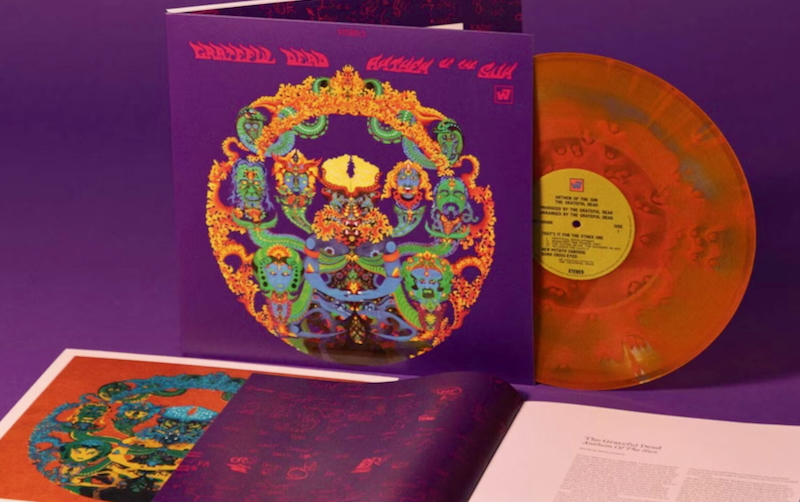
Like the man said, When the going gets weird, the weird turn pro.
The Grateful Dead, famed more in 1967 for their name than their music, spent much of the year stung by the reception of their highly anticipated debut album.
Although the album had its moments, for the most part “The Grateful Dead” was a thin and tinny collection dominated by blues and folk covers. Its cover art was psychedelic all right, but nothing else on the album qualified.
Instead of making a straight-ahead follow-up, the Dead wanted to somehow capture the chaos and head-shredding experience of their concerts. They decided to mix studio and live recordings into a sonic “collage” that would sprawl across both sides of the album.
The heavy lifting in post-production was done by guitarist Jerry Garcia and bassist Phil Lesh. They called the album “Anthem of the Sun.” It was released in the summer of 1968.
“Phil and I performed the mix as if it were an electronic music composition,” Garcia recalled decades later.
The Dead announced their resurrection at the top of side 1 with 7 minutes and 39 seconds of breathtaking experimentation called, “That’s It for the Other One.” Those sounds would reverberate for the rest of the band’s career.
The avant-garde vibe was amplified by band pal Tom Constanten, a pianist and composer. He was an Air Force sergeant who favored musique concrète and studio techniques influenced by composters such as Karlheinz Stockhausen and John Cage. Constanten was a talented miner of “found sounds.”
Constanten made his contributions while on a series of three-day passes. He later called his involvement with the hippie band “a magic carpet ride.”
Constanten, who upon discharge joined the Dead for three albums, was a known associate of avant-garde heavies Steve Reich and Terry Riley.
His involvement allowed the band to marry its loosey-goosey psychedelic sounds — developed in the acid tests of the mid-1960s — with the equally controversial car-wreck stylings of electronic-music composers such as Stockhausen.
“We mixed (the album) for the hallucinations,” Garcia would say. Producer David Hassinger wasn’t charmed — he walked about a third of the way through the recording sessions in L.A.
Compared with the folk-rock sounds produced under Hassinger, the result sounded as if it came from another planet. The union of electronic and psychedelic sounds was attempted by a handful of 1960s acts, but none more memorable than what was found on “Anthem of the Sun.”
“That’s It for the Other One,” the album’s opening number, sprawled across four sections: “Cryptical Envelopment,” “Quadlibet for Tenderfeet,” “The Faster We Go, the Rounder We Get” and “We Leave the Castle.” In a sense it was all one song, all of it in the key of E, although the titles apparently were assigned for publishing reasons.
In part 1 of the song cycle Garcia plays lilting guitar and sings of a man “who has to die” — the guitarist later said the lyric was his roundabout interpretation of Calvary. It’s a deceptively straightforward opening to a major slab of psychedelia. “Cryptical Envelopment” was one of the few Grateful Dead songs with lyrics written by Garcia.
“The Other One’s” weirdness gets going at about 1:30, in the “Quadlibet” section, when the band’s twin drummers lead the band into a brief but heavy jam. (The album was percussionist Mickey Hart’s debut with the Dead.) The section gets much of its punch in transitions between studio and live recordings, the latter recorded in California’s famous psychedelic ballrooms.
“The Faster We Go” was written by drummer Bill Kreutzmann and Bob Weir, the rhythm guitarist. Weir speed-sings his way through the story of a “Spanish lady” whose rose “left a smoking crater of my mind.”
It comes with the famous infectious chorus, some sweet relief that keeps “The Other One” suite from collapsing upon itself: “Comin’, comin’, comin’ around, comin’ around, comin’ around …” It’s the chorus that inspired a million patchouli-fueled attempts at Sufi whirling.
In the second part of the song, Weir eulogizes Beat Generation idol Neal Cassady, whose exploits included driving the Merry Pranksters’ psychedelic school bus.
Weir sings:
“The bus came by and I got on / That’s when it all began / There was cowboy Neal / At the wheel/ Of a bus to never-ever land”
The song remained one of the Dead’s most-performed numbers, often tagged as simply “The Other One.”
Further fierce jamming leads into the darkly surreal instrumental section “We Leave the Castle,” created by Constanten. “Castle” is a masterpiece of futuristic squeaks and squawks; cinematic and heavy on apocalyptic overtones.