Big Brother guitarist James Gurley dies
December 23, 2009
Big Brother and the Holding Company member James Gurley, once dubbed the “father of psychededlic guitar,” has died at the age of 69.
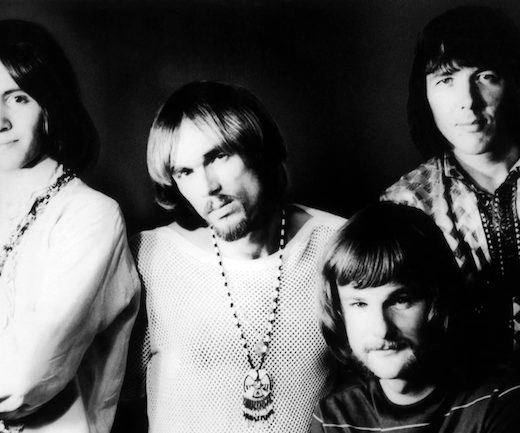
Gurley (center in photo, with Big Brother) died of a heart attack at his Palm Springs home, two days before his 70th birthday.
Big Brother guitarist Sam Andrew wrote on the band’s web site that “James was the spirit and the essence of the band in its early days. He showed us the way as a Zen master would show the way.” Country Joe and the Fish lead guitarist Barry Melton has called him “the Yuri Gagarin of psychedelic guitar … the first man in space.”
Gurly played on the band’s recordings with Janis Joplin, notably “Ball and Chain” and “Piece of My Heart.” His screaching intro to “Cheap Thrills” is among the best known guitar performances of the psychedelic era. Guitar Player magazine listed Gurley and Andrew’s off-modal work on “Summertime” as one of the best psychedelic solos ever recorded.
Gurley was a self-taught guitarist, who closely studied the recordings of bluesman Lightnin’ Hopkins. He moved to San Francisco in the early 1960s and played the coffee-house circuit as a folk musician, as did many of the musicians who would later shape the psychedelic “San Francisco Sound.”
“He was plugged into the early San Francisco scene before the rest of us were,” Andrew told the Marin Independent Journal.
Rock promoter and psychedelic music patron Chet Helms brought Gurley into the young Big Brother and the Holding Company, which built a following around his aggressive, high-volume, amp-abusing playing style. He was the band’s first star, until Helms imported Texas singer Janis Joplin.
In a Big Brother web site tribute, drummer David Getz recalled the first time he heard Gurley: “I’d never heard anyone play guitar like that, heard a sound like that. It was this frenzy of notes that took one to the kind of place that people like Ornette Coleman and John Coltrane were trying to reach, not something you expected to hear from a rock band.”
Rolling Stone’s Lester Bangs called Gurley’s playing “a searing storm of noise … directed (at listeners) with a kind of joyous fury.”
Big Brother as a band often drew fire for ragged playing, often attributed to drug use. Joplin soon left the group, taking Andrew with her. Gurley recalled the superstar’s departure as “a sick morass of disgusting slime.”
Gurley played bass in the post-Joplin Big Brother, which recorded several albums before disbanding in 1972. (The married guitarist and Joplin apparently had an affair in the band’s early days.) He joined Andrew and Getz in a reunited Big Brother in 1987, remaining a member until 1996, when he left on bad terms.
Gurley had a long history of drug-related problems. In 1970 he was charged with second-degree murder in the heroin overdose of his wife, but was acquitted.
In later years, he released solo albums (”Pipe Dreams,” “St. James”) and worked in new age and space rock. He formed a musical partnership with percussionist Muruga Booker. “I didn’t want people to come hear me play and want “Ball and Chain,” Gurley said of the solo works.
Gurley is survived by his second wife and two sons. Big Brother is planning a benefit performance for Gurley’s family early next year.
Julian Lennon remembers ‘Lucy’
November 26, 2009
The real-life Lucy of “Lucy in the Skies With Diamonds” is inspiring Julian Lennon once again. On Dec. 15, he’s releasing the single “Lucy” in her memory, with proceeds going to fight lupus, the disease that killed her.
Lucy Vodden’s death in September reminded Beatle fans of the genesis of the “Sgt. Pepper” psychedelic classic.
Julian, John Lennon’s son, brought home a picture he’d drawn in preschool. He titled it “Lucy in the Sky With Diamonds,” providing his dad with material for the song.
Lennon always maintained the song was about the boy’s drawing, not LSD, but the content and initials suggested otherwise.
The new “Lucy” song was being recorded by Julian Lennon’s colleague James Scott Cook near the time of Vodden’s death at age 46. Lennon and Cook rewrote some of the lyrics and cut the “Lucy” record as a duet. Cook’s grandmother, Lucy, also suffers from lupus.
Lennon looked up his old classmate after learning she had the autoimmune disease. “She created millions with her name,” he told USA Today. “The least I could do was try to support her and make sure she was comfortable.”
Vodden, who died at 46, tried to keep a low profile regarding the song. She liked the Beatles, but not “Lucy in the Sky with Diamonds.” “I don’t relate to the song, to that type of song,” she told the Associated Press before she died.
The “Lucy” EP will feature a foldout copy of the original Lennon drawing (pictured). The digital download will be exclusive to the iTunes Store for now, as was the 40th anniversary release of “Give Peace a Chance” released by Lennon, Sean Lennon and Yoko Ono earlier this month. That single benefited the United Nations Peacebuilding Fund.
Lennon runs a new digital-media record label — theRevolution — whose first release will be “Lucy.” Next year Lennon plans to release an album, “Everything Changes.” The musician and filmmaker has not released new music in almost a decade.
“Lucy in the Sky with Diamonds” is a top 10 entry on our list of the Top 100 Psychedelic Songs of all time.
Brian Jones death probe renewed in U.K.
August 31, 2009
The open-and-shut ruling that Rolling Stones guitarist Brian Jones died of “misadventure” is getting another look from British police. Fans have long suspected the rock star was murdered in 1969.
Police in the southeast county of Sussex police confirmed Aug. 31 that they had received new information on the mysterious death and were re-examining the 40-year-old case. The ruling of “death by misadventure” basically meant the troubled rock musician drowned while under the influence of drugs and alcohol.
“These papers will be examined by Sussex Police but it is too early to comment at this time on what the outcome will be,” a spokesman said. The review does not necessarily mean there will be a full new investigation.
Interest in the death was renewed four years ago with the release of the movie “Stoned” (aka “The Wild and Wycked World of Brian Jones”). The work of “historical fiction” suggested Jones was killed by a builder over a debt. Several books have claimed that the worker, Frank Thorogood, killed Jones and there are reports he confessed as he was dying.
Circumstances surrounding the incident are as complicated as they are mysterious, according to U.K. journalist Scott Jones, who spent several years researching the Brian Jones death. Jones (no relation) reportedly was the journalist who turned over 600 documents on the case.
In 2005, the investigation was reopened after a 150-page report on the Brian Jones case came from a team of investigators working with a fan club and one of guitarist’ ex-girlfriends.
Jones had been dismissed from the Stones weeks before his death, largely because of his drug-addled lifestyle. (The photo at right shows his condition at the “Rock and Roll Circus” filming.)
Jones was allowed to announce the departure, saying: “I no longer see eye-to-eye with the others over the discs we are cutting.” Jones, who started the band and named it as a tribute to Muddy Waters, objected to the Stones’ shift away from the American blues music he loved.
Despite his rep as a blues purist, Jones brought numerous unusual instruments into the band’s late-’60s recordings, such as the sitar, tambura, dulcimer, mellotron, theramin and harpsichord. His playing loomed large on the Stones’ 1967 psychedelic album “Their Satanic Majesties Request,” which was seen as a half-hearted response to the Beatles’ “Sgt. Pepper’s Lonely Hearts Club Band” (No. 4 on our list of the top psychedelic albums.)
Brian Jones also played a key early role in the introduction of world music into rock, recording the Moroccan music that formed the album “Brian Jones Presents the Pipes of Pan at Joujouka.”
Jones is also remembered for his role in fashion, leading the way for many British musicians, especially in the psychedelic music era. He dressed to blow minds while blowing his own on dope.
Here’s a video of “We Love You” from the 1967 psychedelic album. Sadly, Jones is trashed, as was typical in those days.
Sky Saxon of the Seeds dies; garage guru
June 26, 2009
Garage band icon Sky Saxon has died after a long career that included pop stardom with the Seeds and psychedelic explorations as a solo act. He was sixtysomething.
Saxon died Thursday in his new home of Austin, Texas, as he was preparing for a ’60s tour with the Electric Prunes and Love. The cause of death was not disclosed.
Saxon’s latest group was called Shapes Have Fangs, reflecting the singer’s eccentricity as well as his love of oddly titled songs and curious band names. He adopted the name Sky Sunlight Saxon in the years after the Seeds disbanded. Richard Marsh, his real name, was born in Utah.
The Seeds’ two albums remain a powerful influence on rock music, ranging from the jukebox hits “Pushin’ Too Hard” and “Can’t Seem to Make You Mine” to the sex saga “Up in Her Room,” clocking in at 15 minutes. The song “Mr. Farmer” has become another signature song over the years and was heard in the rock movie “Almost Famous.”
Saxon and his L.A.-based Seeds obviously influenced Jim Morrison and the Doors, who had supported them on tour. “The End,” for example, appears to be a direct cop of Saxon’s spooky baritone narration. In turn, Saxon explored some Doors-like directions after the original Seeds disbanded.
The Seeds provided a bridge between some of the original three-chord attitude rockers such as the Kingsmen and the edgier psychedelic bands. Later, the Seeds’ brand of garage rock reverberated throughout the punk rock movement. Generations of rockers have covered Saxon’s songs.
The bands’ two albums, “The Seeds” and “A Web of Sound,” are available as a two-fer CD, as are the Saxon albums “The Future” and “A Full Spoon of Speedy Blues”
. (continued)
The Seeds reunited in 2004 for the album “Red Planet,” which retained the fuzz tone guitars and Farfisa organ sound of their mid-’60s recordings.
Several of Saxon’s post-Seeds records are out of print or only available as imports. “Transparency” (2005) is available via Amazon. Other recordings such as the original release of “Future”
with the Seeds go for as much as $100. He was big in Japan. (View the Sky Saxon discography.)
Saxon recorded with the Smashing Pumpkins leader Billy Corgan last year and appeared in one of that band’s psychedelically influenced music videos.
Saxon was a member of the famed L.A. commune the Source Family and performed with its psychedelic jam band the YaHoWha.
Saxon’s wife, Sabrina, announced the death on her Facebook page: “Sky has passed over and YaHoWha is waiting for him at the gate. He will soon be home with his Father. I’m so sorry I couldn’t keep him here with us. More later. I’m sorry.”
Update: A tribute to Sky Saxon at the EchoPlex in L.A. featured Billy Corgan from the Smashing Pumpkins, the surviving members of the Seeds, the Strawberry Alarm Clock and the Electric Prunes. Here’s an outstanding video of Corgan and a one-time band (including Smashing Pumpkin Mark Byrne and SAC organist Mark Weitz) working out to Saxon’s “900 Million People Daily (All Making Love).”
Soft Machine’s Hugh Hopper dies
June 12, 2009
The bassist Hugh Hopper, a contributor to a sea of progressive bands but best known for his tenure with Britain’s pathfinding Soft Machine, has died. He was 64.
Hopper was one of the central figures in the Canterbury music scene, both before and after his days with Soft Machine. He joined the band as a roadie and then took over on bass in 1968, after the departure of founder Kevin Ayers.
He was among the first bassists to successfully apply fuzz-tone effects to the instrument. His playing anticipated the jazz-rock styles of Jaco Pastorious and Stanley Clarke, but Hopper’s playing was rarely flashy. He had a Motown-like dedication to anchoring the ensemble playing.
Hopper played and contributed songs to almost all of the Soft Machine’s classic works (the second through sixth albums), as the band moved from psychedelic musings to fusion/progressive rock.
One of the most influential Hopper compositions was the trippy, noisy, sometimes atonal “Facelift,” which opened the “Third” album, clocking in at 19 minutes. The avant-garde showcase brought to mind the contemporaneous explorations of Frank Zappa and Miles Davis.
On the “Fourth” album, he contributed “Kings and Queens,” a more traditional jazz rock piece with a cinematic feel. His Soft Machine song “Memories” was recorded by Whitney Houston. (continued)
Hugh Hopper was an early innovator in the use of tape loops as foundations for instrumental improvisation. His first solo album, after he left Soft Machine in 1973, include a side-long sonic collage.
The bassist fronted his own bands and also worked with Gong, Carla Bley, Dave Stewart, Stomu Yamash’ta and Gary Windo, among many others.
Hopper worked with most of the like-minded European players of the past four decades. His long list of collaborators included old Soft Machine mates such as Elton Dean, the free jazz saxophonist.
In the new century, Hopper celebrated his Soft Machine years in the bands Soft Works and Soft Machine Legacy.
The bassist worked until June 2008, when he had to cancel a tour of Japan due to back problems. He then learned he had leukemia. Several benefit concerts helped cover medical expenses. Hopper died June 7 in the county of Kent, England, two days after marrying his longtime girlfriend.
Pink Floyd’s Richard Wright dies
January 21, 2009
Pink Floyd keyboardist and founding member Richard Wright has died at age 65.
Wright’s circus of sounds — odd, spooky, lush or piercing as the occasion required — was the foundation of the psychedelic music the London-based band rode to the top of the rock world.
Guitarist/singer David Gilmour said: “In the welter of arguments about who or what was Pink Floyd, Rick’s enormous input was frequently forgotten. He was gentle, unassuming and private but his soulful voice and playing were vital, magical components of our most recognized Pink Floyd sound.”
Wright co-wrote the “Dark Side of the Moon” centerpiece “The Great Gig in the Sky” and contributed to almost all of the band’s classics of 1960s psychedelia.
Wright was born in London in 1943. In school, he joined a rock and R&B band with guitarist Roger Waters and drummer Nick Mason, playing American covers under various names, including the Tea Set.
Syd Barrett joined the group, which became Pink Floyd. Barrett steered the band toward a mix of curious twee pop, and then into the early works that led to full-blown psychedelia on albums like “Ummagumma,” “Atom Heart Mother” and “Meddle.” Barrett, who died in 2006, left Pink Floyd as a result of his LSD use and mental problems.
(Wright, left, is pictured with Barrett.)
The keyboardist released a pair of solo albums. He clashed with Waters and left the band briefly. Wright reunited with Gilmour and Mason in the fractured Pink Floyd that survived the stormy exit of Waters in 1985.
Wright died on Sept. 15, 2008. The cause of death was cancer, his publicist said.