Major Grateful Dead exhibit at Rock Hall
January 22, 2012
The exhibition “Grateful Dead: The Long, Strange Trip” opens April 12 at the Rock and Roll Hall of Fame, in time for the 2012 artist inductions.
Highlights are to include five Jerry Garcia guitars, “finished and working manuscripts” for classic Dead songs, gear from the Owsley “Wall of Sound” PA system, and artworks such as Fillmore posters and album graphics.
The Grateful Dead Archive at the University of California-Santa Cruz “loaned a significant number of items” from its collection, the Rock Hall said. Rock Hall curator Howard Kramer said he had full access to the Dead’s warehouse.
Longtime Grateful Dead percussionist Mickey Hart will perform at the exhibit opening. One of his psychedelic custom-painted drum kits will among the museum offerings.
The first major showing of the Grateful Dead archives at the University of California Santa Cruz was at the New-York Historical Museum in early 2010.
The Rock and Roll Hall of Fame exhibition “Grateful Dead: The Long, Strange Trip” runs through December at the Cleveland, Ohio, museum.
Pink Floyd ‘Wish’ comes true on SACD
January 20, 2012
Pink Floyd appears to have a hit on SACD — or what passes for a hit in that low-profile audiophile format.
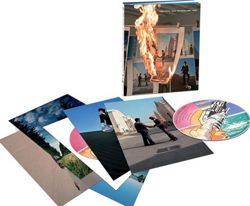
The specialty label Analogue Productions released the Pink Floyd album “Wish You Were Here” on a 5.1 SACD late last year, and now reports that it’s “easily the biggest SACD title in the catalog.”
First a bit of history: Super Audio CD (SACD) was introduced in 1999 but failed to catch on with the public, despite quality that’s sometimes billed as four times as good as CDs.
After a burst of activity (2002-2005) that saw releases of classic albums such as Pink Floyd’s “The Dark Side of the Moon” and the Who’s “Tommy,” the format staggered and appeared to be pretty much a goner by the end of the 2000s.
“In retrospect, SACD and (rival format) DVD-A never had a chance,” the Guardian duly reported in 2007.
Yet SACD soldiered on, catering mostly to classical music fans. Audiophile label Analogue Productions (aka Acoustic Sounds), now a decade old, also found a market in jazz albums from Blue Note. Longtime audiophile specialists Mobile Fidelity also remains active with SACDs. (Both labels are quite active in high-end vinyl as well.) Now, improbably, SACD has made a comeback.
“Wish You Were Here,” the Pink Floyd album that followed “Dark Side of the Moon,” arrived on SACD as part of EMI’s huge Why Pink Floyd…? campaign that began last fall. The SACD was created via the original analog master tapes with the 5.1 mix done by the band’s producer/engineer James Guthrie, who reportedly worked on the project for several years.
It is first multichannel presentation of “Wish You Were Here,” Analogue Productions says. The label has “exclusive distribution rights” to the album, which comes to SACD with a price tag of $35. (It’s not available on Amazon as of this writing.)
Critics and fans are turning in raves, mostly. “Guthrie’s expert, musically impeccable multichannel remix added depth and clarity to the superb original,” the Audio Beat’s Paul Bolin wrote in November. “How he got Richard Wright’s ARP string to orbit the room several feet above my head has to be the result of some sort of voodoo.”
Guthrie has said he’d like to make “The Wall” the next Pink Floyd multitrack album, if and when there are more SACDs.
On Nov. 4, EMI rereleased the CD of “Wish You Were Here” in “Immersion” and “Experience” editions.
In addition to the two Pink Floyd albums and “Tommy,” currently available SACD titles with a psychedelic flavor include all of the Doors’ studio albums; the Moody Blues’ “On the Threshold of a Dream” and “To Our Children’s Chidren’s Children”; the Beach Boys’ “Pet Sounds”; and Santana’s “Caravanserai.”
(As with all things audio, the potential for excellence does not always equal excellence, so be sure to check out the reviews.)
Some current Blu-ray players are built to handle SACD signals, as is the PlayStation 3 game console. Hybrid SACDs such as “Wish You Were Here” will play on all CD players since traditional stereo tracks are included, but performance would be the same as from a well-made regular CD.
No. 79: ‘San Francisco Girls’
January 16, 2012
Fever Tree was another in the long line of Texas bands that migrated to California in the psychedelic era.
Before the Houston group made its move, however, it celebrated the charms of the Bay Area ladies with “San Francisco Girls (Return of the Native),” an intriguing single that (barely) cracked the Billboard singles chart in 1968.
“San Francisco Girls,” written by manager/producers Scott and Vivian Holtzman, came on the heels of the 1967 hits “San Francisco (Be Sure to Wear Flowers in Your Hair)” sung by Scott McKenzie and “San Franciscan Nights” by Eric Burdon. Fever Tree’s song certainly holds up its end of that city trilogy.
“San Francisco Girls” opens as a ballad with a tasty but improbable dance of harpsichord and cymbal. Vocalist Dennis Keller sets the scene as a flute eases in:
Out there it’s summertime
milk and honey days
Oh, San Francisco girls with
San Francisco ways
The reverie is short-lived: A guitar amped for heavy sustain repeats and speeds the opening theme until the song works itself into a gallup.
The singer then delivers the cold-hearted kiss-off at the heart of the story — perhaps importing the ‘tude from Fever Tree’s garage-band days:
Don’t try to stop me girl, you can’t have your way
Don’t try to stop me girl, nothin’ you can say
Live like you wanna live and stay where you wanna stay
I just gotta go and get back to the Bay
The tempo shifts several more times before the cinematic finale is ushered in by soaring sustain-drenched guitar.
“San Francisco Girls” gets its punch from guitarist Michael Knust and percussionist John Tuttle. The elegance comes from classically trained multinstrumentalist Rob Landes, who did the harpsichord bit. Producer David Angel of “Forever Changes” fame apparently worked on the song as well.
(Coincidence, no doubt, but “San Francisco Girls” brings to mind the Guess Who’s “American Woman,” of two years later, right down to Burton Cummings’ vocals.)
“San Francisco Girls (Return of the Native)” brought a modest fame to Fever Tree and endured as a free-form FM favorite.
The original band issued one compelling album, “Fever Tree,” featuring several tracks of the same quality as “San Francisco Girls” as well as some contemporary covers. Sundazed recently rereleased this, Fever Tree’s first album.
Then came the less ambitious “Another Time, Another Place” and the career-crashing “Creation.”
Sundazed also has released “Live ’69″ on vinyl/download (the band’s farewell performance).
Jerry Garcia documentary film on way
January 6, 2012
Another Jerry Garcia feature film is in the wings as documentary maker Malcolm Leo (“This Is Elvis”) confirmed plans to release what’s dubbed “Jerry: The Movie.”
Update: The filmmakers are “currently in talks” with several distributors, a spokeswoman for the project told PsychedelicSight.com. “Jerry: The Movie” is aiming for a spring 2012 release.
The 42,000 in attendance at the San Francisco Giants’ Jerry Garcia Day last summer got a sneak peek of the docu while filmmakers were busy shooting more footage. Behind the camera that day was Justin Kreutzmann, the son of Grateful Dead drummer Bill Kreutzmann, who’s listed as a co-producer on the documentary.
The film’s based on three hours of conversation Leo shared with Garcia in 1987, a decade before the Grateful Dead guitarist’s death.
“The historic interview was shot on negative film with studio quality sound and lighting,” the producers said in a release, noting that they had secured rights.
The Garcia movie web site refers to it as “Jerry: The Movie,” but that could well be a working title since no name is identified in the press materials.
The filmmakers promise unseen concert footage and “rare home movies.”
Another Garcia movie, “Dark Star,” was announced in 2010 and is marked on imdb for a 2012 release. It’s a biopic about Garcia’s younger years, based on the book “Dark Star: An Oral Biography of Jerry Garcia.”
For the documentary, Leo’s producing partner is John Hartmann, described as the former manager of Peter, Paul & Mary, Crosby, Stills & Nash, the Eagles and Poco. Hartmann apparently is the brother of the late comedian Phil Hartmann.
Leo’s credits include the films “This Is Elvis” and “The Beach Boys: An American Band.” For TV he presentations include “Crosby, Stills & Nash: Long Time Comin,’” “Red Hot & Blue” and “Rolling Stone: 20 Years of Rock ‘n Roll.”
Bill Kreutzmann’s credits include the short film “Backstage Pass,” a documentary, as well as a pair of videos connected to the Who.
Sean Bonniwell of Music Machine dies
January 5, 2012
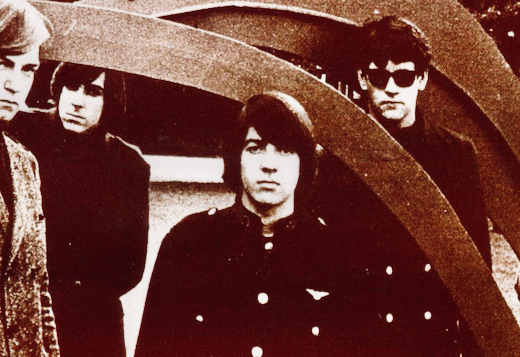
Sean Bonniwell, leader of the dark-edged 1960s band the Music Machine, has died. He was 71.
The Music Machine had one hit single — 1966′s blazing “Talk Talk” — and produced only one album with its classic lineup. Still, the fuzz-and-Farfisa band is remembered as a vanguard act — an important link from garage rock to moody psychedelic rock and then the proto-punk bands.
Bonniwell wrote most of the Music Machine’s songs and fronted the L.A. band, which was known for wearing all black on stage — the garb including a single leather glove.
Rolling Stone headlined its appreciation of Sean Bonniwell: “The Dark Prince of Garage Rock.”
Bonniwell, a born-again Christian, left the music business as the 1960s faded away. He died Dec. 20, 2011, of lung cancer, in Visalia, Calif., various sources said.
“(Turn On) The Music Machine,” the first album, featured a half-dozen Bonniwell originals, notably “Masculine Intuition” and “The People in Me.” The songs appeared to be part self-therapy as Bonniwell inventoried his demons on vinyl. (Note: The first album appears in various forms, but seems to be best represented on Ultimate Turn On per Bonniwell’s web site.)
Routinely lumped in with garage bands, the Music Machine produced a more ambitious sound that brought to mind L.A. contemporaries Love — and anticipated bands-to-be such as Iron Butterfly and the Crazy World of Arthur Brown. Bonniwell sang in “Masculine Intuition”: “I’ve got a masculine intuition/And it/Do/Not/Never be wrong,” right in line with vintage Arthur Lee.
Unfortunately, the first album (on the dinky Original Sound label) was filled out with cover versions (“Cherry Cherry” and a great “Hey Joe”), leaving a stunning but skimpy record of Bonniwell at his peak. Band members reportedly quit over Bonniwell’s auteur approach, some of them forming the group Millennium.
Bonniwell signed with Warners and released a second album, called “The Bonniwell Music Machine.” Much of the material was recorded previously and it produced no hits. The Warner recordings can be found on Sundazed’s 1996 collection Beyond the Garage.
Bonniwell published his memoirs in 1996, also titled “Talk Talk.” He recorded a couple of solo albums and performed his Music Machine material on occasion, sometimes doctoring the lyrics to reflect his Christian bearings. Bonniwell recently marketed a Music Machine video documentary on his web site. (text continues)
Personal note: My first band, the Pack, popped up in 1966. Ft. Lauderdale, Fla. We stole the name from Terry Knight and the Pack. We copped the look from the Music Machine — black on black. We played “Talk Talk” and “Masculine Intuition,” and the rest of the songs came from the Yardbirds. Chris Campbell played drums. I sang and played bass. Wish I could remember the guitarist’s name, think it was Jerry.