The Dead: One more movie night
April 29, 2011
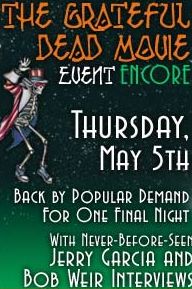
“The Grateful Dead Movie” gets a second revival on Thursday, May 5, following up on its successful “one night only” screenings of April 20.
Now it’s “one final night,” with screenings at 7:30 p.m. local time on the 5th. The distributor/promoters are Fathom and Rhino Entertainment. The Dead movie is being redistributed to cinemas via Fathom Entertainment’s digital cinema network.
Of the 540 screens used in April, 108 are back in action.
Check out the lineup of “Grateful Dead Movie” cinemas. Organizers say that not all ticket arrangements have been finalized, so check back if they’re not available for your local bijou.
Other than the April 20 screening, “The Grateful Dead Movie” has not seen in mainstream cinemas since 1977.
The film offers a mix of performance, documentary footage and animation. It was filmed at Winterland Arena in 1974, during what was to be the Dead’s farewell appearances. The two screenings in 2010 advertised “exclusive” interviews with Jerry Garcia as well.
Austin’s 4th Psych Fest ready to roll
April 27, 2011
Austin’s Psych Fest is in full bloom this year, with its lineup of 58 head-spinning bands hitting the stage starting Friday.
The city’s psychedelic music legend Roky Erikson headlines, along with Spectrum (U.K.) and festival mainstays the Black Angels.
Musicians Christian Bland and Alex Maas of Black Angels are producers of the Austin Psych Fest, along with Rob Fitzpatrick and Oswald James (collectively the Reverberation Appreciation Society). Last year’s festival attracted about 50 bands. The 2008 version had 10 acts.
“It all stems from our particular aesthetic of choice — psychedelic — visual or sonic art that is unexpected or surreal, something that takes you to another place,” Fitzpatrick told the local Community Impact newspaper.
The festival was inspired by the legacy of Erikson and his 13th Floor Elevators of the 1960s. The Black Angels have toured with the eccentric Austin musician, whose latest album has won critical praise.
Tickets are $40 a day (Friday, Saturday, Sunday) or $100 for all three days. Seaholm Power Plant is the venue, with two stages running, with performance times staggered a bit. Britain’s Spectrum (Peter Kember) headlines Saturday while the Black Angels and Erikson close down the fest’s main stage Sunday.
Organizers to fans (via Facebook): “Lets pretend it’s 1968 & everyone doesn’t have a blog & cam in their pocket, lets watch the bands and not 1000 phones in the air, deal?”
And … the festival has a dash of advice for would-be trippers: “Don’t bring anything illegal.” (Full schedule below video)
Austin Psych Fest 2011 lineup:
Friday, April 29
Stage 1
6:30: ZaZa
7:30: Beach Fossils
8:30: Night Beats
9:30: Atlas Sound
10:30: Crystal Stilts
11:30: A Place to Bury Strangers
12:30: Omar A Rodriguez
Stage 2
5:30: Christian Bland
6:00: Sky Drops
7:00: Zechs Marquis
8:00: Blue Angel Lounge
9:00: Radio Moscow
10:00: Quarter After
11:00: Shapes Have Fangs
12:00: No Joy
1:00: Tobacco
2:00: This Will Destroy You
Saturday, April 30
Stage 1
2:30: Ghost Box Orchestra
3:30: Woodsman
4:30: Shine Brothers
5:30: Beaches
6:30: Black Ryder
7:30: Sleepy Sun
8:30: Fresh and Onlys
9:30: Crocodiles
10:30: Prefuse 73
11:30: Black Moth Super Rainbow
12:30: Spectrum
Stage 2
2:00: Holy Wave
3:00: Weird Owl
4:00: Vacant Lots
5:00: Cloudland Canyon
6:00: Pontiak
7:00: White Hills
8:00: Lumerians
9:00: Young Prisms
10:00: Indian Jewelry
11:00: Soft Moon
12:00: Lower Heaven
1:00: Bass Drum of Death
2:00: The Meek
Sunday, May 1
Stage 1
3:30: Diamond Center
4:30: Fungi Girls
5:30: Black Hollies
6:30: Dirty Beaches
7:30: Pete International Airport
8:30: The Growlers
9:30: Roky Erickson
10:45: The Black Angels
Stage 2
3:00: Hellfire Social
3:30: Chris Catalena
4:00: Tjutjuna
5:00: ST37
6:00: Daughters of the Sun
7:00: The Cult of Dom Keller
8:00: Wall of Death
9:00: Cold Sun
12:00: My Education/Theta Naught: Sound Mass
Brains! Flaming Lips seal songs in skull
April 6, 2011
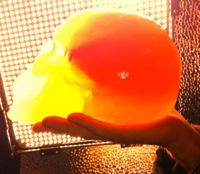
The Flaming Lips want you to eat their brains. The band’s continuing explorations of odd ways to distribute psychedelic music in the new century have led to songs hidden inside gummy candy skulls.
Four new Lips tunes will be implanted in a USB drive (memory stick) deep within the sticky brain. Listeners are encouraged to eat the candy skull, and then the brains (more than 7 pounds of gelatin, enjoy.) Extract the USB drive, find a way to clean it (good luck) and then insert into computer.
The band’s last release, “Two Blobs Fucking,” came out as a streaming single, with 12 separate mono parts designed to be played simultaneously on iPhones. The result: “lo-fi symphonic joy.” Lips fans have spent the past month and a half coming up with unique ways to play that one.
“I’d just like to release music all the time and just put it out in all kinds of weird formats and not just collect it until we’re ready to put out [an album] every two years or so,” Coyne told billboard.com. The songs also will come out on iTunes.
The Flaming Lips also plan to release “Heady Nuggs: The First 5 Warner Bros. Records 1992-2002″ on Record Store Day, April 16, 2011. The five catalog recordings are “Hit to Death In the Future Head” (1992), “Transmissions From the Satellite Heart” (1993), “Clouds Taste Metallic” (1995) and “The Soft Bulletin” (1990) and “Yoshimi Battles the Pink Robots” (2002).
Speaking of the psychedelic “Yoshimi Battles the Pink Robots,” it could be the next rock album to try its luck on Broadway. The long-delayed project appears to be in pre-production.
The Flaming Lips are working with Southern California stage director Des McAnuff (“Jersey Boys”). He’s the guy who work-shopped the Who’s “Tommy” at the La Jolla Playhouse and brought the production to Broadway for a long successful run.
The “Yoshimi Battles the Pink Robots” musical “really has become a perfect combination of my fantastical robot-world vision and (McAnuff’s) little, internal, humanistic version of what that music is,” Coyne told Billboard the other day.
The plot revolves around a dying girl (“Her name is Yoshimi, she’s a black-belt in karate”) who enters another dimension with a boyfriend and takes on her disease, which lurks there in the form of pink robots. Lips frontman Wayne Coyne told Entertainment Weekly (which apparently broke the story) in 2007 that the madness should play out along the lines of Terry Gilliam’s bizarre “Brazil.”
The Lips have continued to wave their freak flag over the years. They released a remake of Pink Floyd’s “The Dark Side of the Moon” in April 2010, billed as the Flaming Lips & Stardeath and White Dwarfs With Henry Rollins and Peaches.
No. 66: ‘Hey Joe’ by Jimi Hendrix
April 6, 2011
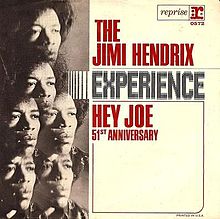
“Hey Joe” seems like it’s been around since the frontier days, but when Jimi Hendrix recorded that tale of a revenge and murder, it was only 5 years old or so.
In that short time, “Hey Joe” — aka “Hey Joe, Where You Gonna Go” — had been covered by the Leaves, Love, the Byrds, the Music Machine, the Shadows of Knight and the Standells, along with every garage band on your old block.
The Leaves hit the charts with their third recording of the number, in 1966, although the year before the song had spread like wildfire through the California rock scene.
Most sources agree that the author was U.S. folkie Billy Roberts, who holds the copyright. The singer-songwriter Dino Valenti was credited as the author on some recordings, although that may have been with Roberts’ blessing.
Tim Rose, who probably started the fiction that “Hey Joe” was a traditional song, took to playing “Hey Joe” as a slow burner. Rose, too, claimed partial songwriting credit.
Hendrix’s version credits Roberts as the writer, but in the liner notes the guitarist calls it “a blues arrangement of an old cowboy song that’s about 100 years old.” Hendrix probably was joking, but it added another red herring to the “Hey Joe” saga. (Read all about the clusterfuck that is “Hey Joe’s” history.)
Tim Rose’s version of “Hey Joe” probably inspired Hendrix to make it part of his act before going to England — the Rose and Hendrix versions are similar in pace, arrangement and vocal backing.
Slowing down high-speed rockers and making them “heavy” was a staple technique of psychedelic rock in those years (see Iron Butterfly, Vanilla Fudge and Blue Cheer), so Hendrix could have have gotten there on his own.
The Jimi Hendrix Experience’s “Hey Joe” opens as a straightforward blues, with Hendrix alternating his vocal delivery a tad to emphasize the question-and-answer format. The female backup singers are fairly hot in the mix, at the request of the guitarist, still trying to find his voice as a frontman.
For the first half, Mitch Mitchell’s drums and Noel Redding’s bass simply keep the beat. As the song moves forward the drumming becomes increasingly aggressive, a suggestion, perhaps, that Joe is starting to lose it. This is a conversation, after all, with a murderer fresh from the kill.
At the 1:40 minute-mark, “Hey Joe” morphs into an Experience song, as Mitchell’s now-busy playing reaches full speed and Redding delivers the signature bass line (used by most bands from “Hey Joe’s” beginning). Hendrix issues a fluid solo, short and simple.
By song’s end, head-banging is in full effect.
The Jimi Hendrix Experience’s “Hey Joe” of 1966 remains by far the best-known versions of the song, and certainly one of the best. It appeared on the first Experience album in the States as the third track on side 1. In England, “Hey Joe” was the group’s first single (b/w “Stone Free” in December 1966) and as such wasn’t included on the album (as with many Beatles hits). The U.K. omission was made right in the CD era.
Like most of Hendrix’s top songs, “Hey Joe” found its way into several movies and TV series, including “Star Trek: Deep Space Nine.” “Forrest Gump,” “Wayne’s World 2,” “The Wild Life” and “Crooklyn.”