Elektra’s journey through the past

August 13, 2010

elektra records albums artistsUp for some time travel? Elektra Records surveys its 60-year history via an outstanding multimedia journey that’s available online.

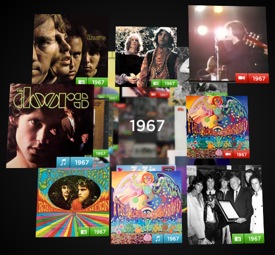
Curated by label founder Jac Holzman, Elektra60.com is built around a graphics-heavy interactive timeline. It launches immediately upon visiting the page, transporting visitors from 2010 to 1950 in most trippy fashion, as if they fell into a “2001″ black hole. Images flash by, roots music plays. Worth the visit alone.

Holzman signees the Doors, Love and Incredible String Band fly the psychedelic music banner. Other heavy acts include the Paul Butterfield Blues Band, the MC5 and the Stooges.

“It was modeled on a world’s fair, where a visitor can walk down the center promenade and take in the sights and sounds, and step into multiple pavilions for more enriching experiences,” Jac Holzman iconsays. Once inside the virtual tent, users can listen to a few songs, view the discography, see a video or two.

Users scroll across a bar to visit individual years, which coolly and colorfully morph into each other.

In 2007, the label released an audio box set that celebrated its glory years: "Forever Changing: The Golden Age of Elektra 1963-1973."
icon

This time, “We decided to celebrate Elektra on the Web, the connective community of our age,” said Holzman, who sold the label to Warner in the 1970s and is now an adviser to Warner Music Group chief Edgar Bronfman Jr.

The multimedia Elektra60.com actually is an adjunct to the label’s primary web site, with content flowing between the two.

For example, the radio series “The Doors: From the Inside” originates on the main site, but fits in perfectly with the historical content on Elektra60.com. The Doors’ radio special, originally aired in 1988, takes a chronological look at Elektra’s most controversial and profitable act. Like the 60.com project, it breaks down the band’s history into six years: 1966-1971.

Another key piece of content looks at the Elektra label chiefs and the artists they signed. Holzman, of course, had the hottest hand, with Love, the Doors, Butterfield, the Stooges, Judy Collins and Queen, among others. David Geffen’s Asylum acts have been added to the mix, bringing in Joni Mitchell, Tom Waits, Dylan and Jackson Browne.

Elektra60.com remains a work in progress — there are some noticeable bugs and gaps (go to an artist’s bio and the post initially is headlined “About me” (as in Phil Ochs, About Me, ouch). The first page doesn’t have a mute or skip, so you get the full treatment every time you visit, possibly annoying.

“Elektra60.com is a living, breathing site that will continue to evolve over the upcoming weeks and months, as fresh content is added and new paths revealed,” Holzman says.

The digital agency Rokkan produced the interactive timeline.

Meanwhile, Britain’s NME marks the 40th anniversary of Jimi Hendrix’s passing with a special issue. Parts of the tribute to the greatest psychedelic guitar player of all time are available online, such as “20 Things You Never Knew About Jimi Hendrix.”

Live Jefferson Airplane CDs sound familiar
August 5, 2010

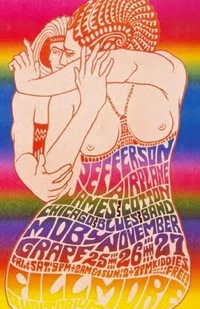
jefferson airplane live in 1966CDs of the Jefferson Airplane’s live performances have been pretty limited over the years, but that’s about to change.

The Collectors’ Choice Music Live series plans a quartet of live albums from 1966-68, including one that captures Grace Slick’s debut as the band’s vocalist. The CDs are due Oct. 26.

Knowledgeable fans won’t get too worked up. These four recordings already are well-traveled on the Internet, most prominently on the authorized online music service Wolfgang’s Vault.

Meanwhile, on the Grateful Dead beat, Warner and Rhino get back to vinyl with "The Warner Studio Albums,"
icon a five-LP boxed set. It marks the 40th anniversaries of “Workingman’s Dead” and “American Beauty.” List price for the Dead LP set is $135; shipping starts Sept. 21.

MP3 downloads of the same four Jefferson Airplane concertsicon (and many more) are for sale on Wolfgang’s Vault for $4 to $10 a shot. Audio ranges from just OK to surprisingly good.

Some of these recordings came to Wolfgang’s as part of a music and memorabilia deal with the Airplane, Starship and Hot Tuna that was announced a month ago.

Band guitarist Jorma Kaukonen said at the time: “These recordings are like a window into a time long gone and vaguely remembered. I hear them and I find myself saying, ‘We were pretty good!’ I’m glad somebody saved them for posterity.”

The CDs set for fall release are “Live at the Fillmore Auditorium 10/15/66 Late Show”; “Signe’s Farewell, Live at the Fillmore Auditorium 10/16/66″; “Early & Late Shows — Grace’s Debut, Live at the Fillmore Auditorium 11/25/66 & 11/27/66″ — “We Have Ignition, and Return to the Matrix 2/1/68.” We’re guessing these are working titles.

Packaged with the CDs digipacks are notes by Craig Trent ("Take Me to a Circus Tent: The Jefferson Airplane Flight Manual"icon) and “rare photos.”

Collector’s Choice’s Music Live label took flight this year with releases by Johnny Winter, Hot Tuna and Poco.

Sony’s Legacy series released a live double-CD Airplane album last year as part of its well-received “Woodstock Experience” series.

grateful dead albums on vinyl coverThe Grateful Dead vinyl set’s albums are “The Grateful Dead” (1967), the psychedelic duo “Anthem of the Sun” (1968, original mix) and “Aoxomoxoa” (1969, original mix), “Workingman’s Dead” (1970) and “American Beauty” (1970). The Dead box set comes with a 1967 single version of “Dark Star” (b/w “Born Cross-Eyed”) if you make buy via dead.net

The Dead albums come on 180-gram vinyl at RTI using lacquers cut from the original analog masters by Chris Bellman at Bernie Grundman Mastering.

No. 28: ‘Help, I’m a Rock’

August 1, 2010

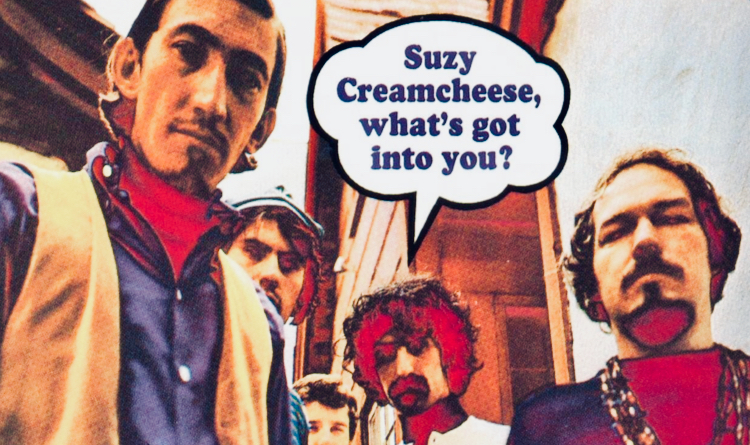
mothers of invention freak_out albumFrank Zappa took no drugs, but his headphone masterpiece “Help, I’m a Rock” launched zillions of LSD trips back in 1966.

That’s “Rock” as in acid rock.

Zappa explained this nine-minute serving of madness as the result of a bunch of people fooling around in the studio. “It was just a thing that spewed out,” Zappa said a decade later. “What was happening was what was in the air that night.”

Those madmen happened to be ace musicians, making the extended piece as much an exercise in free-form jazz as in psychedelic music. “Note the interesting formal structure,” Zappa deadpans in the liner notes.

“Help, I’m a Rock” delivered the goods to wannabe hipsters drawn to the Mothers of Invention’s first album by the promise of a “Freak Out!” (Mostly, the listeners received a heavy dose of greasy pop parodies and dip-shit doo-wop.)

Young Zappa schooled himself in multitracking before he ever got a record deal. Here he layers screams, duck calls, alien beeps and chatter, tribal chants, a female orgasm — all in the service of the deadpan vocal drone “Help, I’m a Rock.”

For a while, the lyrics go something like this, with rock producer Kim Fowley speaking in tongues …

Ay-yo ee-ow-ee-ow-ee
Veni-ma-no too mah
Veni veni ka toree tor (see’dra votra nee!)
Vedi-vedi ki-ta-la tom-bay
Vel-lay ka-la tay-la-tor
Vel-lay kay-la ta-la-sor
Vel-lay kay-lay ka-la-tor

… and then we hear from the Rock itself (Zappa):

Wow, man, it’s a drag being a rock
I wish I was anything but a rock
Heck, I’d even like to be a policeman
Hey, you know what?
You know maybe if I practice, you know
Maybe if I pass my driving test
I could get a gig driving that bus that pick the freaks up
In front of Ben Frank’s, right?

Before long comes the ghostly question: “Who can imagine, that they would freak out in Kansas?” (and other unlikely spots) — a clutch of vocal nonsense prefacing a Cecil Taylor/Sun Ra-inspired detour into space jazz, with piano solo by Zappa. Spaced is the place.

One reviewer called Zappa’s “Freak Out!” experiments “the greatest stimulus to the aspirin industry since the income tax.”

“Help, I’m a Rock” started life as a “suite in three movements”: “Okay to Tap Dance,” “In Memoriam Edgar Varese” and “It Can’t Happen Here.” The back album cover and original master tapes from the “Freak Out!” sessions show the title as simply “Help, I’m a Rock.” In the CD era, “It Can’t Happen Here” began to appear as a separate track and it was included solo on some compilations.

In concert, the Mothers would mix “Help, I’m a Rock”with other early Frank Zappa numbers, such as “Hungry Freaks Daddy.”

Zappa wrote in the liner notes of his sonic collage: ” ‘Help, I’m A Rock’ is dedicated to Elvis Presley. Note the interesting formal structure and the stunning four-part barber shop harmony toward the end. Note the obvious lack of commercial potential. Ho hum.”

Long term, the psychedelic workout had plenty of commercial appeal, with Zappa’s bands playing it throughout the master’s career. “Help, I’m a Rock” became one of the many catch phrases attached to Zappa over his career.

An abbreviated “Help I’m a Rock” was released as the B-side to the 1966 DJ-only single “How Could I Be Such a Fool.”

The studio recording’s players were Zappa, Ray Collins, Black, Roy Estrada (“boy soprano”) and Elliot Ingber.

Get Adobe Flash playerPlugin by wpburn.com wordpress themes