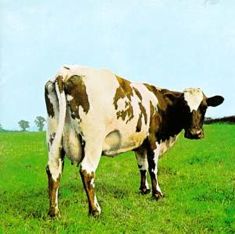
No. 50: ‘Atom Heart Mother’ suite
June 28, 2010
The year 1970 found Pink Floyd in search of a title for their latest musical exploration, a psychedelic suite of sorts.
Roger Waters picked up a copy of the Evening Standard newspaper, in which he found a story about a woman about to receive a nuclear-powered pacemaker.
Voila!
And so we have “Atom Heart Mother,” one of the band’s most-debated works, a sprawling suite that’s by turns exhilarating, monotonous, hypnotic, pretentious and primeval.
Waters, creator of “The Wall,” later suggested that the piece should “never (be) listened to by anyone ever again.” Guitarist David Gilmour called it “pretty horrible” — “absolute crap.”
Rolling Stone agreed, calling the suite “awful schmaltzy” and “a step headlong into the last century … a dissipation of (Pink Floyd’s) collective talents.”
So of course plenty of Pink Floyd diehards love the “Atom Heart Mother” suite, all 24 minutes of it.
In 1970, Pink Floyd had been performing in concert an extended piece that would come to be variously known as “Theme From an Imaginary Western,” “Epic” and “Amazing Pudding.” Gilmour and Waters reportedly wanted to write a classically structured work around its themes, but came up frustrated. They turned to British avant-garde composer Ron Geesin, who’d done an offbeat side project with Waters.
Geesin arranged the work, calling in the John Aldiss Choir and an orchestral brass section, which collectively soared above the psychedelic band’s basic tracks of guitar, drums and keyboards. Of the Pink Floyd members, only Gilmour gets a solo section. Other key instruments in the piece are French horns and cello.
The suite consisted of six parts, the parameters of each on the fuzzy side:
- Father’s Shout
- Breast Milky
- Mother Fore
- Funky Dung
- Mind Your Throats, Please
- Remergence
Father’s Shout sneaks in with 30 seconds of near-silence — a faint buzz. French horns manage a woobly fanfare, soon set straight by a display of of Pink Floyd’s rock muscle. We hear horses and motorcycles moving through as the French horns play bravely on, establishing the “Atom Heart Mother” theme.
Breast Milky offers a cello part, framed by Richard Wright’s loopy organ riff and a supple bass. Gilmour’s slide guitar turns things back to rock, with the horns reasserting the suite’s theme.
In Mother Fore, the choir sings as if in Mass, backed by Hammond B-3 organ. Here is the softest of these six passages. The rock band returns in the lengthy section’s final minute, providing much-needed relief.
Gilmour’s guitar and Wright’s B-3 take the wheel in Funky Dung, a white boy blues jam straight out of 10 Years After. The chorus goes native, descending into an aggressive chant right out of “The Exorcist.” The main theme returns in full throat, drums pounding as the French horns slice the air. Here is “Atom Heart Mother” at its best.
The section Mind Your Throats, Please, at first recalls the Beatles’ “Number Nine,” electronic noodling evolving into metallic din. The careful listener is rewarded here … while others may flee. Gilmour again wields his slide, coaxing band, choir and horns back to full power. The choir ends it all with a heroic burst that’s straight out of a swords-and-sandals score.
While the critics stood about unimpressed, the “Atom Heart Mother” album went to No. 1 in Britain. Stanley Kubrick was among the fans of the curious suite: He sought permission to use the work in “A Clockwork Orange,” but was denied. (The director subsequently refused to let Waters borrow images from “2001: A Space Odyssey.”)
Despite Gilmour’s dumping on the suite over the years, he turned up to play his guitar part when pal Geesin revived “Atom Heart Mother” in 2008, complete with chorus and orchestra.
As with all things Pink, fans on YouTube have posted some inspired takes on “Atom Heart Mother.” One guy synched it up with scenes from “2001.” (Stanley Kubrick, incidentally, was denied use of the suite for his “A Clockwork Orange.”)
The video below features the digital art of Ryan Bliss.
View the other parts of the “Atom Heart Mother” videos: Breast Milky / Mother Fore and Funky Dung / Remergence
Furthur live on Sirius; town halts show
June 27, 2010
Reason to be grateful: Sirius XM is doing a live broadcast of Furthur’s tour stop in tiny Jim Thorpe, Pa.
Reason to be bummed: The July 5 show at the Shelburne Museum in Vermont was abruptly canceled because of fears of damage to the facility. One angry fan called it “Grateful Dead paranoia at its best.”
The Tuesday, June 29, concert on satellite radio comes from Penn’s Peak, a 1,600-seat club, making it the most intimate performance of Furthur’s current tour. (The concert, of course, is rock solid sold out.) The live broadcast begins at 7 p.m. ET on the 3-year-old Dead Channel.
Satellite radio fans will hear the Furthur concert on XM channel 57 and Sirius 32. The co-host of the Grateful Dead Channel’s “Tales from the Golden Road” talk show, Gary Lambert, will take calls from Deadheads during the break.
Bob Weir and Phil Lesh’s project is one of the many descendants of the Grateful Dead. It debuted about a year ago and has been on the road most of 2010.
Of the canceled Vermont show, the band said it was “regrettably unable to find a suitable alternate venue in Vermont,” and switched that date to the Sherman Theatre in Stroudsburg, Pa. Tickets from the Vermont show will be refunded, but not honored at the Sherman gig, which sold out in eight minutes.
The Vermont promoter complained on the Furthur web site: “For these concerns to materialize in the 11th hour and our solutions to be deemed ‘inadequate’ is short-sighted.” The show would have been part of the Ben & Jerry’s Concerts on the Green series.
The town’s fears of Furthur, apparently, were of problems with Dead heads showing up on the museum grounds without tickets.
“This is Grateful Dead paranoia at its best,” one local fan told the Burlington Free Press. “This show was no threat to the museum or anyone else.”
Paranoia about concerns certainly runs deep in the Northeast this month after a near riot in Manhattan at a free show by rapper Drake. An expected crowd of 10,000 fans turned into 25,000 and the show was canceled without the performer taking the stage.
The (latest and second) lineup of Furthur consists of Weir (guitar, vocals), Lesh (bass), Jeff Chimenti (keyboards), John Kadlecik (guitar), Joe Russo (drums), and Sunshine Becker and Jeff Pherson (vocals). The musicians have ties to the family of Grateful Dead-related acts such as Dark Star Orchestra and RatDog.
The ever-changing set list looks familiar to Deadheads, of course: “Touch of Grey,” “Looks Like Rain,” “Eyes of the World,” “Here Comes Sunshine,” “Brokedown Palace,” “Ship of Fools,” “Truckin’” and “Turn on Your Lovelight.”
Furthur is named for the 1939 school bus owned by Ken Kesey and used in the ’60s as psychedelic transport for the trippy writer and his extended family, the Merry Pranksters.
More Grateful Dead content:
- Jerry Garcia biopic brewing in Hollywood
- Grateful Dead’s history a Society affair
No. 30: ‘The Flock’
June 23, 2010
The Flock would go on to record other ace songs, but what is arguably the band’s finest moment comes on side 1, track 1 of album No. 1 — the instrumental duet “Introduction.”A collision of psychedelic rock and classical music, the number features the band’s most dramatic player, the violinist Jerry Goodman. At five minutes long, it’s an intricate and ultimately aggressive piece of music held together by the flowing guitar work of bandleader Fred Glickstein.
“Introduction” goes from a whisper to a scream, with passages both conventional and savage. The hard rock comes into play only at the end, as the seven-member Flock emerges only to play one crushing final chord.
Like their hometown contemporaries Chicago Transit Authority, the Flock relied heavily on electric guitar and horns. But the sound took a wicked quantum leap thanks to Goodman, a conservatory-trained violinist who had been the band’s guitar tech. (Perhaps the apt comparison here is with Al Kooper’s first version of Blood, Sweat and Tears, another ambitious brass band fond of psychedelic-influenced experimentation.)
What made the Flock interesting — radical dynamics, flirtations with audio anarchy, oddball lyrics and high-pitched vocals — also seemed to doom any hopes of rock stardom. Theirs was head music, influenced as much by “Bitches Brew” as “Revolver.” (CTA, meanwhile, became the hugely successful Chicago after ditching any hippie influences.)
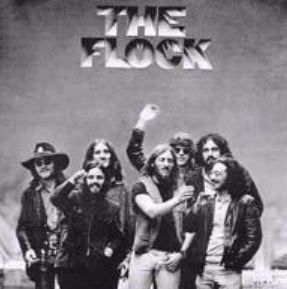
“The Flock” (1969) released by Columbia, contains only six songs, thanks to the inclusion of a 15-minute blues workout.
Bluesmaster John Mayall wrote the album liner notes after catching the band at Aaron Russo’s Kinetic Playground in Chicago (think Fillmore Midwest).
“I got close to going berserk over their prodigious and varied musical talent,” Mayall said. “(It’s) an exciting new direction in contemporary music, a subtle fusion of sounds drawn from the bedrock of blues, jazz, gospel, rock, country and many other sources.” (Mayall later used a violinist in his jazz-rock fusion band.)
Back to the album. “Introduction” runs directly into “Clown,” another of the band’s best songs sung by Glickstein.
At almost 8 minutes, “Clown” plays like a Chicago Transit Authority-style rocker until just past the 2-minute mark, when Goodman cranks through a violin solo, embossed by Jerry Smith’s insistent bass work. After that, we’re in for an extended some psychedelic/prog variations with a wisp of raga. The band sounds lost at some point, like they’re tuning up on acid. A sax solo helicopters in from afar. With a minute to spare, the band returns to the safety of rock. The label didn’t hear a single.Distant ethereal vocals announce the arrival of “I Am the Tall Tree.” Pastoral violin and perhaps flute.
The lyrics paint curious images:
Brown sugar lips through the naked eye
Blimp floating high on an aqua sky
Ride the slide narrow to wide
As deep as creation’s infinityIndeed. There’s still time for one of those Flock 180s, as singers cry in alarm, “The rushes are coming, the rushes are coming.” Zappa meets Gilbert & Sullivan.
The next two numbers feature fine vocals and guitar work from Fred Glickstein. After some startling scratching by Goodman, we’re into fuzz guitar and a rousing cover of the Kinks’ “Tired of Waiting on You.”
“Store Bought Store Thought” — a fan favorite — charges in as another straight-up rock song, albeit with twinkly King Crimson-like interlude. The lyrics go sci-fi:
Robot, robot, arms and legs
Teeth, bones, hair, it’s all there
Robot, robot, arms and legs
Battery’s dead, head’s dead.
(Mechanical man, mechanical man!)“Truth” seems a typical ’60s white boy blues, until we hear the violin take the lead in place of electric guitar. Terrific for a while. Lengthy blues jams were common enough in those days; this one provides one of the band’s rare nods to hipster conventions.
The debut album proved to be the Flock’s finest hour, by far. Followup “Dinosaur Swamps” (1970) had its moments, but the band collapsed in its wake.
“The Flock” appears to be out of print, after a CD release in 1996. “The Flock” album
was combined with “Dinosaur Swamps” on a bargain CD. There exists a decent “Flock Rock”
best-of album with decent sound. The band’s music also is available via MP3 downloads.
Jerry Goodman moved on to John McLaughlin’s fiery Mahavishnu Orchestra and toured with the rock-jazz fusionists Dixie Dreggs, both all-instrumental bands. He released a trio of solo albums in the 1980s and continued to work into the new century.
Over the years, Glickstein gathered the Flock in a couple of forms, touring and squeezing out one lightly regarded studio album in 1975. Note: The Flock discussed in this review is technically the second edition of the band, the first releasing some pop singles from 1966-68.
Here’s an outstanding, high-quality video of Goodman and Glickstein playing “Introduction”:
Garry Shider dies: P-Funk guitarist, director
June 18, 2010
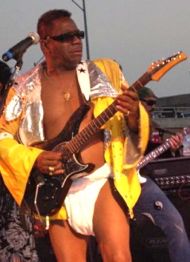
Garry “Diaperman” Shider, the longtime musical director for George Clinton’s various psychedelic funk bands, died June 16. He was 56.The guitarist and singer joined Parliament and Funkadelic during their peak creative years, working on “Maggot Brain,” “One Nation Under a Groove” and “America Eats Its Young.” Shider continued with Clinton and his P-Funk All-Stars through an April tour, which he briefly joined despite just being diagnosed with brain and lung cancer.
He co-wrote some of Clinton’s best-known songs, notably “Atomic Dog” and “One Nation Under a Groove.”
Shider found funk fame for wearing the white loincloth that became his trademark, hence the Diaperman handle. The P-Funk world also knew him as “Starchild.”
“Thank you, Garry, for all you have done,” Clinton wrote on his web site. “Forever Funkin’ On!” The site’s long list of Parliament/Funkadelic musicians has Shider’s name second, right below Clinton’s.
Shider shared the middle name “Marshall” with Jimi Hendrix, a deep influence on his guitar playing (video below).
In the ’70s, Shider played in Parliament/Funkadelic with soon-to-be-legend Eddie Hazel, whose psychedelic epic “Maggot Brain” served as a showcase for the guitarists. (“Maggot Brain
” is included on this web site’s list of the “Greatest Psychedelic Songs.”)
Shider was inducted into the Rock and Roll Hall of Fame in 1997, along with other members of Parliament/Funkadelic.
Other gigs included Bootsy Collins’ Rubber Band, the Black Crowes and outside work with Hazel. Shider’s songs also ended up on various Hollywood soundtracks, including “Bad Boys.” Clinton produced the recordings of the guitarist’s first band, United Soul.
Shider died in Upper Marlboro, Md. Donations to cover the family’s resulting medical bills can be made on this Sweet Relief-affiliated web site.
Glastonbury fest goes ‘weird, psychedelic’
June 9, 2010
The spiritual descendant of the great 1960s rock festivals, Glastonbury rises once again this week. The shadows of psychedelia lurk around every corner of the English festival, perhaps in response to critics who said bookers were ignoring underground music.Psychedelic-tinged acts at this year’s Glasto include the Flaming Lips, Os Mutantes, Devendra Banhart, Curved Air and George Clinton with Parliament/Funkadelic.
Psychedelic trance, electronica and ’60s-style pop come from the Egg, Orbital, Dead Weather, Holy Fuck, Wax Tailor, Kissmet, Gorillz, MGMT, Egyptian Hip Hop, Grizzly Bear, lcd soundsystem and at least a dozen more (see the impressive Glastonbury artists list). That brew should address criticisms that the festival has been light on “weird psychedelic music.”
Sixties survivors playing the Glastonbury Festival of Contemporary Performing Arts include Stevie Wonder, Ray Davies and Dr. John. Prog/psychedelic acts returning after playing the first fest are Marsupilami, Quintessence and Space Ritual (Hawkwind vets).Don’t book that flight. This year’s festival is sold out, but the BBC plans massive coverage, some of which will seep over into America. Dates are June 23-27.
For a “psychedelic smorgasbord,” fest-goers can check out the on-site club the Rabbit Hole, which promises “a twisted mix of Alice In Wonderland meets the Playboy mansion.” It specializes in underground music and “magic potions.” Dozens of bands are playing the club over the four days, including Elvis (“the real one”).
The progressive poster outfit Firehouse also touches down in Glasto as part of its “Psychedelic Secession” tour (image for MGMT at right).
Promising young acts competing for a slot on the main stage include You Are the Family Machine and the Phantom Light.
It was 40 years ago that the festival came to life — the day after Jimi Hendrix’s death. Fans paid a pound to see Marc Bolan and a handful of other artists, with the ticket price including free milk from the cows wandering about. Today, it’s arguably the world’s best rock festival.
The Isle of Wight festival, with a focus on mainstream rockers, runs June 11-13. Headliners are Sir Paul, the Strokes, Jay-Z, Blondie and Pink.
No. 87: ‘They’re Coming to Take Me Away’
June 4, 2010
As 1966 ushered in the psychedelic era, a New York songwriter got stoned and decided to check out his mind. The result was one of the most sinister and bizarre novelty songs of all time: “They’re Coming to Take Me Away Ha-Haaa!”Who could say how many bad trips this twisted piece of work wrought back in the day.
Working as “Napolean XIV,” Jerry Samuels rapped the story of a man driven insane by the disappearance of his girlfriend (or, ahem, dog).
Borrowing a trick from “The Chipmunks” novelty records (“Alvin!!!”), Samuels used a variable frequency oscillator to speed his voice to various maniacal levels. He addressed the evil woman (or faithless dog) in first person:
Remember when you ran away and I got on my knees and begged you not to
leave because I’d go berserk? Well …
You left me anyhow and then the days got worse and worse and now you see
I’ve gone completely out of my mind. And …
They’re coming to take me away, ha-haaa!! They’re coming to take me away, ho-ho, hee-hee, ha-haaa
To the funny farm. Where life is beautiful all the time …Adding to the intensity was a self-made drum loop that recalled Bob Dylan’s propulsive “Rainy Day Women,” released four months earlier. Samuels says it actually comes from the Scottish march “The Campbells Are Coming” (listen).
Samuels says that during recording he realized he was writing a truly sick song, and put it aside. It wouldn’t die. Later, in an attempt to leaven the creepiness factor, he added a line about the offender being a “mangy mutt.” It didn’t help much.
Kids loved it regardless. “They’re Coming to Take Me Away Ha-Haaa!” shot to the top of the charts, pounding out of jukeboxes and car radios nationwide.
Adding to the bizarre history, Napolean XIV used a backward version of the song as the B-side of the 45. “!aaaH-aH ,yawA eM ekaT oT gnimoC er’yehT” was a forerunner of the “Rick Roll” meme, with kids eagerly inflicting it on captive audiences, such as people eating in diners. The rock critic Dave Marsh
dubbed this backward menace “the most obnoxious song ever to appear in a jukebox.”
The A-side single, meanwhile, was banned by various radio stations, including WMCA and WABC in New York. “It was a hit before it got banned,” Samuels said. “Once it got banned, it was finished.”
Jerry Samuels, who performs standards and such these days, discussed the making of “They’re Coming to Take Me Away Ha-Haaa!” in a definitive Napolean XIV interview posted by Song Facts.
Rhino reissued the Napolean XIV album in the 1980s and then again in expanded form in the 1990s (“The Second Coming
.”)
This most twisted of novelty songs lives on today, having lost none of its sonic jolt. It has inspired various YouTube shorts and covers by indie bands such as Lard and Neurotic Fish (below). Let’s just hope Tarantino doesn’t get his hands on it.