No. 30: ‘Iron Butterfly Theme’
March 28, 2010
Probably a coincidence, but Iron Butterfly beat Led Zeppelin to that heavy-light name game by at least a year. You know, the iron (or led), as ballast for the delicate flying creature (or dirigible).
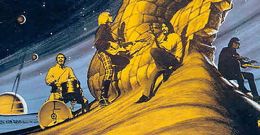
The Southern California band also anticipated Led Zep’s mix of punishing riffs and ethereal wails with “Iron Butterfly Theme,” a wordless monster of a song that set an early standard for hard acid rock.
The 4 1/2-minute instrumental, recorded in 1967, demonstrates why Iron Butterfly has been called “the father of heavy metal” by Def Leppard and other headbangers. The Butterfly boys even called the album “Heavy.”
“Theme” covers the life cycle of an iron butterfly, beginning with the throbs of birth, then the exhilarating flight, then the crash-and-burn accompanied by the devils of feedback and anarchy.
Throughout, keyboardist Doug Ingle’s organ dances and duels with Danny Weis’ distorted guitar as tribal drums pound away. As a coda, Morse code announces the death of the bellowing beast … fade to black. It’s as cinematic a song as there is in rock.
Nothing quite like “Iron Butterfly Theme” had been recorded before, except, perhaps, for the sonic chaos of the Beatles’ “Tomorrow Never Knows.” This was proto-metal, as if Pink Floyd had recorded while tripping on horse tranquilizers.
Giving the song its unshakable creepiness is Ingle’s chanting — the echo of demented monks, perhaps. A warning of medieval horrors to come. Or, at least, something from the slab at Hammer Films.
There also exists a heroic quality that summons up another movie — picture a Schwarzeneggerian warrior holding his blade high to the skies, seeking the final reward of a lightning bolt. Like in “Heavy Metal” the movie, come to think of it.
Ingle called the group’s sound an exercise in “melodic consciousness.” That path soon would lead to “In-A-Gadda-Da-Vida,” the 17-minute psychedelic slog for which the band is remembered today.
Fame came fast and faded in a few short years. The group was a victim of its musical bloat and inconsistent recordings — outplayed and outflanked by other West Coast psychedelic bands.
But for that first glorious 4 1/2 minutes, Iron Butterfly soared.
Hendrix: the man with the plastic guitar
March 27, 2010
New Rolling Stone cover boy Jimi Hendrix is coming to the game “Rock Band,” in the latest marketing move from the late guitar god’s estate.
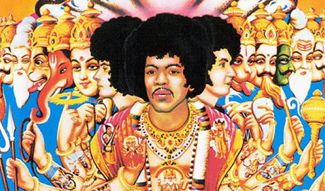
“Axis: Bold as Love” kicks off the Hendrix gaming releases, along with a download of the “new” Hendrix single, “Valleys of Neptune.”
Meanwhile, on the album charts, “Valleys of Neptune,” which debuted at No. 4 on the Billboard 200, this week slips to No. 7. “Are You Experienced” fell from 44 to 118, “Electric Ladyland” saw its No. 60 turn into No. 164 and “Axis Bold as Love” went from 67 to 178.
Rolling Stone, which first reported on the Hendrix Rock Band, said a Hendrix avatar, plastic game guitars and Beatles-style game are possibly in the mix once all songs are available for download.
The “Axis” songs plus “Neptune” come to XBox360 and Nintendo Wii on March 30 and to PS3 two days later. Unfortunately, the “Axis”-opening alien skit “EXP” has been dumped as “not suitable for game play,” instead of logically pairing it with “Up From the Skies.”
The songs will go for the standard price of $2, while the album is available for $20. A few songs are being withheld for the LEGO Rock Band. (Beware of fake-guitar-shattering tantrums once Junior figures out he’s not getting “Castles Made of Sand.”)
An MTV Games exec told Rolling Stone that the songs would have “improved sonics,” which would be odd but welcome since fans are dismissing the Hendrix reissues as having audio that’s identical to the 1997 CDs.
Due for download release on Rock Band are the first three classic Hendrix albums plus the posthumous “First Rays of the Rising Sun.”
The Hendrix family said in February that a Hendrix-themed Rock Band game could be coming, but the DLC packs are it for now.
Pink Floyd walls off its concept albums

March 18, 2010
Pink Floyd’s contract with EMI doesn’t allow the music company to cut up the group’s often-seamless concept albums, a British court has ruled.
Judge Andrew Morritt, chancellor of Britain’s High Court, said the psychedelic music pioneers have the right to defend “the artistic integrity” of its albums in both traditional and online media.
Pink Floyd was seeing red over EMI Group’s distribution of individual songs from their concept albums, notably to the iTunes store. The band’s songs, of course, often run together on albums such as “The Wall” and “The Dark Side of the Moon.”
EMI argued that its contract with the band — signed ages before the creation of music downloads — gave it the right to use the songs unbundled, online or off.
The ruling on Pink Floyd’s albums came as part of a long-running lawsuit over the band’s contract and its catalog, one of the richest in rock.
The judge said that EMI is “not entitled to exploit recordings by online distribution or by any other means other than the complete original album without Pink Floyd’s consent.”
Almost a week after the ruling, iTunes was selling “Another Brick in the Wall” and other album cuts for $1.29.
EMI said the ruling clarified a point in the contract but didn’t mean it had to change its slice-and-dice methods: “Today’s judgment does not require EMI to cease making Pink Floyd’s catalogue available as single track downloads, and EMI continues to sell Pink Floyd’s music digitally and in other formats,” the label said in a release.
“We’re huge fans of Pink Floyd,” EMI added.
AC/DC and Radiohead lodged similar protests over unbundled albums.
Meanwhile, fans in the U.K. can psyche up their letters with Pink Floyd stamps featuring “The Division Bell.”
Grateful Dead’s history a Society affair
March 6, 2010
Roll over Frederick Douglass and tell Abe Lincoln the news: the Grateful Dead have crashed Manhattan’s local history museum.
Dead heads are flocking to Central Park West this weekend as “Grateful Dead: Now Playing at the New-York Historical Society” debuts.
The exhibit comes almost exclusively from the Grateful Dead archives at the University of California Santa Cruz and is its first major showing. So what’s the Dead memorabilia doing way over there in Manhattan?
The historical society has your answer in one incredibly long sentence: “(The Dead) played in and around New York City on a regular basis, from early dates at Greenwich Village coffeehouses, impromptu performances in Central Park and at Columbia University during the 1968 Student Strike; to concerts at midsized venues, including the Fillmore East, the Academy of Music and the 46th Street Rock Palace in Brooklyn during the 1970s; and, ultimately, to performances at larger halls and stadiums such as Radio City Music Hall, Madison Square Garden and Giants Stadium.
“The Grateful Dead’s time in New York will be viewed in the context of cultural traditions and events unique to New York, but also as yet another stop on a long, strange touring trip that included dates in New York, San Francisco, and everywhere in between,” the museum explained.
Another reason: the Dead archive materials remain mostly warehoused in Santa Cruz, as the university prepares primo exhibition space as a permanent home.
Goodies on display include the band’s famed psychedelic concert posters, trippy set lists, album art such as the “American Beauty” cover, giant marionettes and other stage props, banners and crazy funky fan mail. Band documents include evidence of their early decisions to allow free taping by fans.
For those who want take-home, the gift shop is brimming with fun psychedelic stuff.
The Los Angeles Times tracked the Grateful Dead exhibit’s history, which starts improbably with Henry Kissinger, who gave a speech at the museum urging historians to look at the ’60s in order to understand the U.S. A former museum board member copped to being a Dead head and lobbied for a band exhibition as a follow-up on Kissinger’s advice.
The exhibition runs through July 4 — fittingly, as it’s a touchstone holiday for the band and its Uncle Sam.
More Grateful Dead content: