Big Brother guitarist James Gurley dies
December 23, 2009
Big Brother and the Holding Company member James Gurley, once dubbed the “father of psychededlic guitar,” has died at the age of 69.
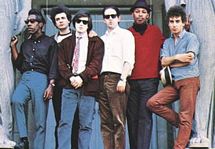
Gurley (center in photo, with Big Brother) died of a heart attack at his Palm Springs home, two days before his 70th birthday.
Big Brother guitarist Sam Andrew wrote on the band’s web site that “James was the spirit and the essence of the band in its early days. He showed us the way as a Zen master would show the way.” Country Joe and the Fish lead guitarist Barry Melton has called him “the Yuri Gagarin of psychedelic guitar … the first man in space.”
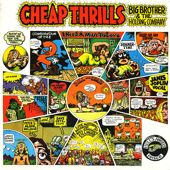
Gurly played on the band’s recordings with Janis Joplin, notably “Ball and Chain” and “Piece of My Heart.” His screaching intro to “Cheap Thrills” is among the best known guitar performances of the psychedelic era. Guitar Player magazine listed Gurley and Andrew’s off-modal work on “Summertime” as one of the best psychedelic solos ever recorded.
Gurley was a self-taught guitarist, who closely studied the recordings of bluesman Lightnin’ Hopkins. He moved to San Francisco in the early 1960s and played the coffee-house circuit as a folk musician, as did many of the musicians who would later shape the psychedelic “San Francisco Sound.”
“He was plugged into the early San Francisco scene before the rest of us were,” Andrew told the Marin Independent Journal.
Rock promoter and psychedelic music patron Chet Helms brought Gurley into the young Big Brother and the Holding Company, which built a following around his aggressive, high-volume, amp-abusing playing style. He was the band’s first star, until Helms imported Texas singer Janis Joplin.
In a Big Brother web site tribute, drummer David Getz recalled the first time he heard Gurley: “I’d never heard anyone play guitar like that, heard a sound like that. It was this frenzy of notes that took one to the kind of place that people like Ornette Coleman and John Coltrane were trying to reach, not something you expected to hear from a rock band.”
Rolling Stone’s Lester Bangs called Gurley’s playing “a searing storm of noise … directed (at listeners) with a kind of joyous fury.”
Big Brother as a band often drew fire for ragged playing, often attributed to drug use. Joplin soon left the group, taking Andrew with her. Gurley recalled the superstar’s departure as “a sick morass of disgusting slime.”
Gurley played bass in the post-Joplin Big Brother, which recorded several albums before disbanding in 1972. (The married guitarist and Joplin apparently had an affair in the band’s early days.) He joined Andrew and Getz in a reunited Big Brother in 1987, remaining a member until 1996, when he left on bad terms.
Gurley had a long history of drug-related problems. In 1970 he was charged with second-degree murder in the heroin overdose of his wife, but was acquitted.
In later years, he released solo albums (”Pipe Dreams,” “St. James”) and worked in new age and space rock. He formed a musical partnership with percussionist Muruga Booker. “I didn’t want people to come hear me play and want “Ball and Chain,” Gurley said of the solo works.
Gurley is survived by his second wife and two sons. Big Brother is planning a benefit performance for Gurley’s family early next year.
No. 20: ‘East/West’
December 21, 2009
In the fall of 1965, the blues guitar prodigy Michael Bloomfield dropped acid. He had a vision, a musical vision, that he said unlocked the secrets of Indian music.
After the all-night psychedelic experience, he began work on “the raga,” an improbable instrumental mash-up of Eastern drones and scales, and Western free jazz, rock and Chicago blues harmonica.
Bloomfield presented the improvisational concept to his fellow players in the Paul Butterfield Blues Band. Until that point, this was a fairly straightforward group out of Chicago — except for its white leader and its interracial mix of musicians.
“East-West” seemed to come out of nowhere, a full-blown shock of the new, but clues to its genesis could be found in the key players’ musical DNA:
Butterfield, a local harmonica player, had been schooled on blues by Muddy Waters (who called him “my son”). Butterfield’s harp playing was fluid and thoughtful. New to the group was Billy Davenport, a jazz drummer whose heroes included Charlie Parker, Gene Krupa and Max Roach. To pay the bills, he played the blues. A second white guitarist, Elvin Bishop, specialized in the often eerie sounds of seminal bluesman Robert Johnson. Keyboardist Mark Naftalin studied music theory and composition.
From this cauldron emerged one of the boldest experiments in the history of blues and rock. The group’s second album, “East-West,” hit the street a year later, its title song running 13-plus minutes. This, however, was not the full-blown “East-West,” which in performance could top an hour’s length.
“This song was based, like Indian music, on a drone,” Naftalin has said. “In Western musical terms it ’stayed on the one.’”
Bloomfield, Butterfield and Bishop take solo turns and come together just the song’s unforgettable climax. The stucture is that of a suite, with different modes (scales) ruling different sections. Bishop takes the first solo spot, with Bloomfield doing the heavy lifting throughout, running through his acid-flash collection of exotic modes while his partner drones along.
Davenport works furiously in the background, applying the (oxymoronic) disciplines of free jazz. He sometimes imitates the tabla and mridanga drummers of Indian sitar ensembles. At other times he plays what sounds like bossa nova/samba.
Butterfield provides ballast and encouragement throughout, before propelling “East-West” in its final minutes, his blues harp channeling Coltrane as the guitars go spinning-dervish around him. At one point, Butterfield responds to the creative chaos with dissonant honks, a brilliant and somehow logical move.
“East/West” influenced many of the California psychedelic bands, lighting the way to free-form improvisation, instrumental textures for their own sakes, dissonance and non-traditional scales. Few of these hippie acts had the musical chops to even approximate the Butterfield band’s achievement, but some did — such as Quicksilver Messenger Service, Santana and to some extent the Grateful Dead.
Bloomfield left the band after the “East-West” album, never to hit those heights again. He died a drug user. Butterfield, too, died early, but not before the spirit of “East-West” infused a series of excellent albums by his growing band, notably 1968’s “In My Own Dream.” Bishop went on to a career in Southern rock and enjoyed a few hit singles.
Indian and Arabic sounds never left rock. The Beatles’ George Harrison, of course, became the highest-profile student of Eastern sounds, studying with the sitar master Ravi Shankar. In 1966, the brought the instruments to the Beatles recordings with “Norwegian Wood.” The Beatles continued with the instrument for several years.
The keyboardist Naftalin gathered together a trio of live live “East-West” recordings (1966-’67) for an album released in 1996. The low-fi recordings track the evolution of the number. The rock critic Dave Marsh wrote the “East/West Live” liner notes, a must read for those seeking an understanding of the song.
Pink Floyd performance from ‘67 unearthed
December 4, 2009
Rare and battered footage of the Syd Barrett-fronted Pink Floyd has been discovered, restored and will screen next month as part of a London preservation festival.
The performance of “See Emily Play” comes from the BBC One Music show “Top of the Pops,” which aired in July 1967 just as Pink Floyd was beginning its recording career.
Steve Bryant, senior curator at the British Film Institute, said: “This is an enormously significant discovery that will generate huge interest amongst music fans all over the world, even though the surviving material is in poor condition.
“Footage of Pink Floyd from this era is extremely rare.”
Bryant said his staff had restored the performance “as much as has been possible.” The footage came from a reel-to-reel tape held by a private collector, reportedly a rock star.
Syd Barrett wrote Pink Floyd’s first three singles, of which “See Emily Play” was the second, peaking on U.K. charts at No. 6. It came from “The Piper at the Gates of Dawn” album, largely made up of Barrett songs. The rock singer’s drug-fueled mental health problems led to his estrangement from the band and eventual departure in the months to follow.
The British Film Institute will show the Pink Floyd footage at its “Missing Believed Wiped” series screenings on Jan. 9.
The “MBW” initiative has unearthed some significant performances from the BBC pop music shows ” Juke Box Juries,” “Thank Your Lucky Stars,” “Ready Steady Go,” Oh Boy!” and “Top of the Pops.”
“Tele-recordings” were routinely erased at the time, especially those in the fading black-and-white format.
In other Pink Floyd doings, the neo-psychedelic band Flaming Lips will perform “Dark Side of the Moon” in its entirety at a New Year’s Eve show in its home state of Oklahoma.
The show at the Cox Convention Center in Oklahoma City features the Lips kicking off side 1 of “Dark Side” at midnight, with assistance from its frequent opening band Stardeath and White Dwarfs. Phish played the album in concert in 1998, Rolling Stone points out.
The Flaming Lips and Stardeath recently recorded “Dark Side of the Moon” for release on iTunes, with guest stars Henry Rollins and Peaches.
Follow this link to the Flaming Lips doing “Eclipse” on KCRW’s “Morning Becomes Eclectic” show (skip to the 30-minute mark to hear the song).
As for “Emily” …