No. 9: A Wizard, a True Star
September 10, 2009
The sound of a synthesized jet straining to reach full throttle opens Todd Rundgren’s “A Wizard, A True Star.” This, paradoxically, is the sound of the artist’s Top 40 career crashing. With the album, Rundgren abandoned the safe confines of radio-friendly power pop for the unknown.
“AWATS” came a year after Rundgren’s 1972 masterpiece “Something/Anything?” a double album that came brimming with great pop songs such as “I Saw the Light,” “Couldn’t I Just Tell You” and the artist’s biggest hit, “Hello It’s Me.”
Pop fans who followed the artist to “A Wizard, A True Star” found themselves confronted with a 12-title song cycle that was full of noise, synthesizers, hard rock and pure psychedelia. This dose of sonic madness took up the first side of the album, while a more traditional rock and soul approach filled out side 2.
The album cover should have been a tip-off. Artist Arthur Wood’s brightly colored psychedelic portrait of Rundgren — inspired, perhaps, by the song “Dada Dali” — came in a die-cut pattern, unheard of at the time. Jungian stars, cubes, mandalas, pyramids and bubbles framed the Picasso-like image of the artist, who appears to sport at least three ears.
Rolling Stone didn’t get it. The reviewer noted side 1 would be better employed as a cartoon soundtrack and went on to complain thusly:
The fealty of Todd’s most devoted fans will be challenged by the form and content of side one of “A Wizard, A True Star.” It is his most experimental, and annoying, effort to date. … Throughout the performance, more a jarring pastiche than a carefully woven tapestry, it sounds like Todd is daring his listeners to keep up with his new direction, which is both ludicrously grandiose and something of a put-on. Here we have an artist who … has run amok.
“Most people couldn’t get through it,” Rundgren says today. “I went off on a weird tangent and the rest is history.”
The new-breed Todd Is God crowd went with the flow. “AWATS” became a classic in the proficient artist’s canon, second perhaps only to “Something/Anything?.” Its status is such that Rundgren has been persuaded to perform the album live, in its entirety, in a series of highly anticipated fall 2009 “A Wizard, A True Star” concerts.
The album’s psychedelic cycle kicks off with “International Feel,” a throbbing, sonically dense number that speaks directly to the artist’s faithful:
“Here we are again, the start of the end,
But there’s more
I only want to see if you’ll give up on me
But there’s always more”
That blast segues into “Never Never Land,” a psychedelic rendering of the “Peter Pan” Broadway number. Rundgren sings tenderly against a swell of Vangelis-like synthesizers. The song attached itself to Rundgren for decades.
The Peter Pan persona was easy enough to conjure up in concert, with Rundgren typically performing with multicolored hair, heavy makeup, feathers and psychedelic duds. Later in the album, in “Is it My Name?” he addresses the less-than-studly vibe:
“My voice goes so high
You would think I was gay
But I play my guitar
In such a man-cock way”
“Never Never Land” gives way to a dizzy quintet of 1-minute songs, ranging from prog-rock blasts to Zappa-esque nonsense. The instrumental “Flamingo” gives Rundgren a chance to show off his synethsizer skills in a circus soundscape.
“Zen Archer,” perhaps the best and strangest number in the cycle, calls up the ghosts of Weil and Brecht with a portrait of a karmic killer. It’s electronic German cabaret — that is, if the cabaret spiked its beer with LSD. “The pretty bird is dying … ”
Rundgren’s lyrics veer from the nonsensical to surreal: His offbeat humor is apparent throughout the album, in songs like “Just Another Onion Heat,” “Dogfight Giggle” and “You Don’t Have to Camp Around.”
“Le Feel Internacionale” closes the dizzy-dozen psychedelic side, its reprise bringing the mind-blown listener full cycle.
The album does have its lush and linear moments, notably the the soul hits medley that brightened side 2 and the anthem “Just One Victory,” which closes many Rundgren concerts.
“AWATS” contained yet another nod to fans: “Wait another year/and Utopia is here.”
Truth in advertising.
More Todd: Read about Rundgren’s ownership of the psychedelic “Fool” guitar that Eric Clapton played in Cream. Aka the Psychedelic SG, it was Rundgren’s main ax throughout the 1970s and can be heard on “A Wizard, a True Star.”
The Beatles remasters: Yeah, yeah, yuck
September 10, 2009
The two new Beatles box sets are in the stores, and the reviews are flying in. They’re almost uniformly positive. Almost.
The reactions run from (the predictable) rave reviews to the (equally predictable) crabbing from Beatles audio purists. Sorting out the Fabs’ various mixes and intentions has always been a messy affair; the pair of Beatles box sets no doubt continues the tradition.
The new releases, of course, are “The Beatles: Stereo Box Set” and “The Beatles Mono Box Set
.”
After wading through dozens of day-and-date reviews, it looks like the consensus (of the better critics) is that the mono mixes are preferable to the stereo, at least up until “Rubber Soul.” From “Revolver” to “Sgt. Pepper’s,” the stereo wins out, with notable exceptions. (”Abbey Road” and “Let It Be” rise above the debate, as they started life in stereo, only.)
Unfortunately, Capitol Records chose not to include both the stereo and mono mixes on the CDs, which would have been an easy fit on most of the albums (the early ones run a half hour or so). Good business. Bad karma.
Another dodgy decision was releasing these treasures to CD only, when DVD-Audio and Blu-ray would have offered much higher-end audio — as well as the option of more Beatles in surround sound.
If the CD format is dying, what a way to go, though.
Here are observations scooped up from various critics; Psychedelic Sight will be reviewing the “psychedelic” Beatles albums in a few.
From the New York Times’ Beatles review:
In most cases this music has dimension and detail that it never had before, and the new packaging reflects each album’s musical and cultural importance. Over all, the new discs sound substantially better than the Beatles’ original CDs, which EMI issued in 1987. The most striking and consistent improvements are a heftier, rounded, three-dimensional bass sound, and drums that now sound like drums, rather than something in the distance being hit. … some discs are improved more radically than others, and some are hardly improved at all.
Reviewer Allan Kozinn says that “some discs are improved more radically than others, and some are hardly improved at all. Probably the most revelatory of the new transfers is the stereo ‘White Album.’ ”
MusicRadar.com weighed in on the Beatles remasters with detailed and authoritative coverage, using two critics to cover 1963-1966 and 1967-1970 separately.
“Should you buy ‘The Beatles In Mono’ and ‘The Beatles Box Set: Remastered In Stereo’? If you are a completist, absolutely. Just don’t expect the stereo box to be the last word. In some cases, better stereo mixes exist elsewhere already, and in others, the mono versions simply have more impact.”
Of the two approaches, the verdict is: “Both have strong, if not essential, selling points.”
Pitchfork.com chimes in on the revived Beatles CDs:
“The sound of these remasters, mono or stereo, is exceptional. I’ve always felt that the sound quality of the original 1987 remasters was slightly underrated. … But whatever you think of the 1987 remasters, these new versions are a marked improvement. In terms of clarity and detail, they are consistently impressive. But they’re also successful for showing restraint.”
Echoing other reviewers, Mark Richardson points to the upgrades for bass and drums, both of which suffered in the 1987 CD releases, which often sounded shrill and thin. (One reviewer actually came to the defense of those discs, but didn’t have company.)
“Listening to the new masters, the differences in sound quality generally manifest in three ways: songs have more ‘punch,’ with Paul McCartney’s bass (an absolute wonder throughout) and Ringo’s drums hitting with more force; the separation is better, so that instruments and (especially) layered vocals have more definition– when the Beatles are harmonizing, you can more easily pick out the different vocalists, and the voices have more presence; and finally, the sound in general seems just a touch brighter, with various sound effects, cymbals taps, and so on, ringing with more clarity.”
CNN singled out one of the later albums: “But it’s perhaps on 1966’s ‘Revolver’ … where the magical mystery work of Abbey Road recording engineer Guy Massey and the many others involved is most apparent.”
Entertainment Weekly went all gushy over the new Beatles box sets:
“Beatlemaniacs of all degrees who re-purchase these beloved albums are in for a listening experience that is nothing short of revelatory. … Never before have the studio explorations of 1966’s ‘Revolver,’ 1967’s ‘Sgt. Pepper’s Lonely Hearts Club Band‘ and beyond felt quite so wondrously otherworldly. … To say the remasters sound perfect would be to miss the point, though. It’s the minute human flaws and unpredictable variations heard so clearly here that make even tunes as overplayed as 1968’s ‘Hey Jude’ (’Past Masters’) or 1969’s ‘Something’ (’Abbey Road’) sound improbably fresh, alive, real.”
Speaking of ‘Hey Jude,’ apparently it’s possible to hear McCartney mutter “fucking hell” as he hits a dud note about 2:60 into the anthem.
Bob Gendron of Tone Audio posted a solid critique of the new Beatles CDs:
“(There are) near-miraculous improvements in the key areas of information retrieval, hidden details, palpable physicality, expanded midrange, transient presence, and frequency response. … Without diminishing the value and impact of the stereo editions, which blow away their 1987 digital predecessors in every imaginable facet, the mono discs are where it’s at for experiencing the Beatles in the most “authentic” manner.”
“For kicks, comparing the 1987 digital issue of ‘Sgt. Pepper’s’ to the new remasters lends perspective to just how awful the former are, and how amazing Capitol’s 2009 entries sound.”
Gendron offers up a solution that’s going to prove expensive, since the mono CDs aren’t sold separately: Owning both the mono and stereo mixes of “Revolver,” “Sgt. Pepper’s,” “Magical Mystery Tour” and “The Beatles (White Album)
” albums “borders on mandatory,” he writes.
Rolling Stone, once the magazine of record for rock reviews, has posted an anemic look at the Beatles box sets that manages to make the case for the mono mixes:
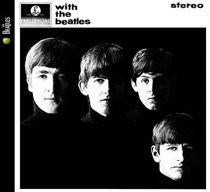
“The 12-CD ‘The Beatles in Mono’ box set is more than a collector’s indulgence. The warmth and punch of early albums ‘With the Beatles’ and ‘Beatles for Sale’ evoke the experience of first hearing songs like ‘All My Loving’ on the original vinyl. But in stereo or mono, these albums have finally received the treatment they deserve.”
Finally, one guy wondered why all the fuss over “the Beatles, a 1960s band so obscure that their music is not even available on iTunes.” A good one, considering 9/9/09 failed to deliver the rumored news that the Fabs’ recordings would finally be available for downloading.
Beatles for sale:
Buy “The Beatles: Stereo Box Set” at Amazon.
Buy “The Beatles Mono Box Set” at Amazon (both discounted).