Brian Jones death probe renewed in U.K.
August 31, 2009
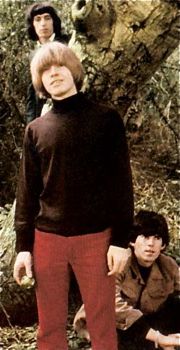
The open-and-shut ruling that Rolling Stones guitarist Brian Jones died of “misadventure” is getting another look from British police. Fans have long suspected the rock star was murdered in 1969.
Police in the southeast county of Sussex police confirmed Aug. 31 that they had received new information on the mysterious death and were re-examining the 40-year-old case. The ruling of “death by misadventure” basically meant the troubled rock musician drowned while under the influence of drugs and alcohol.
“These papers will be examined by Sussex Police but it is too early to comment at this time on what the outcome will be,” a spokesman said. The review does not necessarily mean there will be a full new investigation.
Interest in the death was renewed four years ago with the release of the movie “Stoned” (aka “The Wild and Wycked World of Brian Jones”). The work of “historical fiction” suggested Jones was killed by a builder over a debt. Several books have claimed that the worker, Frank Thorogood, killed Jones and there are reports he confessed as he was dying.
Circumstances surrounding the incident are as complicated as they are mysterious, according to U.K. journalist Scott Jones, who spent several years researching the Brian Jones death. Jones (no relation) reportedly was the journalist who turned over 600 documents on the case.
In 2005, the investigation was reopened after a 150-page report on the Brian Jones case came from a team of investigators working with a fan club and one of guitarist’ ex-girlfriends.
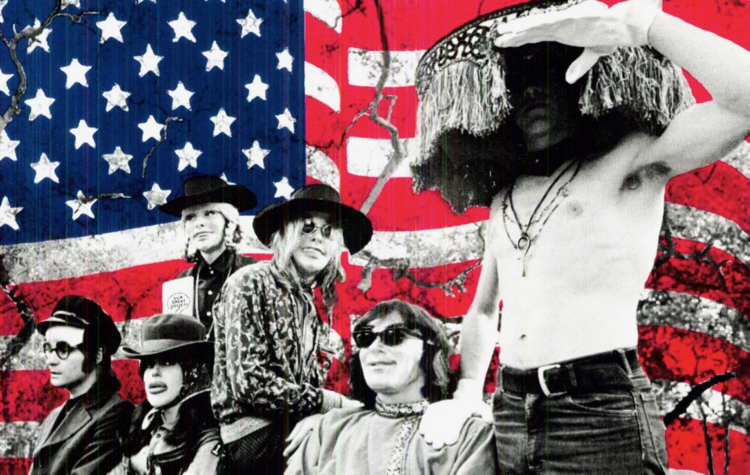
Jones had been dismissed from the Stones weeks before his death, largely because of his drug-addled lifestyle. (The photo at right shows his condition at the “Rock and Roll Circus” filming.)
Jones was allowed to announce the departure, saying: “I no longer see eye-to-eye with the others over the discs we are cutting.” Jones, who started the band and named it as a tribute to Muddy Waters, objected to the Stones’ shift away from the American blues music he loved.
Despite his rep as a blues purist, Jones brought numerous unusual instruments into the band’s late-’60s recordings, such as the sitar, tambura, dulcimer, mellotron, theramin and harpsichord. His playing loomed large on the Stones’ 1967 psychedelic album “Their Satanic Majesties Request,” which was seen as a half-hearted response to the Beatles’ “Sgt. Pepper’s Lonely Hearts Club Band” (No. 4 on our list of the top psychedelic albums.)
Brian Jones also played a key early role in the introduction of world music into rock, recording the Moroccan music that formed the album “Brian Jones Presents the Pipes of Pan at Joujouka.”
Jones is also remembered for his role in fashion, leading the way for many British musicians, especially in the psychedelic music era. He dressed to blow minds while blowing his own on dope.
Here’s a video of “We Love You” from the 1967 psychedelic album. Sadly, Jones is trashed, as was typical in those days.
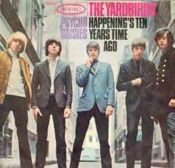
No. 10: Happenings 10 Years Time Ago
August 23, 2009
From the intersection of freak out and rave up comes the Yardbirds’ massive “Happenings Ten Years Time Ago,” often cited as the first psychedelic rock song.
The slash-and-burn number featured the Yardbirds‘ ephemeral duo-guitar attack of Jeff Beck and Jimmy Page. Recorded in July of 1966, the song seemingly touched every other rock musician who mattered for the rest of the decade, notably Jimi Hendrix.
“Happenings Ten Years Time Ago” anticipated acid rock, punk and heavy metal. Nothing like it had ever been recorded — with the possible exception of Love’s frantic “7 and 7 Is,” cut in the same month.
“Happenings” begins innocently enough, with a bit of the raga-influenced guitar that the Yardbirds favored that year. A propulsive run down the guitar neck sparks the sonic storm. Singer Keith Relf sounds dazed and confused as he tries to sort out a waking dream, a serious case of deja vu or perhaps an acid flashback:
Meeting people on my way
Seemingly I’ve known one day
Familiarity of things
That my dreaming always brings
When the Yardbirds’ signature rave-up comes, it’s the sound of chaos, of Vishnu at work, an eerily accurate sonic representation of a bad trip.
As Telecaster masters Beck and Page shred their ways through the instrumental break, we hear a European police siren wailing in and out. There’s an explosion or two and a distant Cockney voice shaming: “Pop group, are you? You should get your hair cut!”
Yardbirds member Chris Dreja recalls it as a “miniature rock opera.” Hendrix reportedly told Beck that the number inspired his “Third Stone From the Sun.”
The song came out as a single a few months after the Yardbirds album now known as “Roger the Engineer” — aka “The Yardbirds” and “Over Under Sideways Down.” It enjoyed modest success on the charts, the last single to do so for the hitmaking band. (”Happenings” now appears as a track on “Roger the Engineer.”)
In the U.K., the “Happenings” flip side had “Psycho Daisies,” a forgettable Jeff Beck song in which he sings about his actress girlfriend. In America, the ballsy bluesy “The Nazz Are Blue” lit up the B side, making for a powerhouse 45. (Young Todd Rundgren named his pop band after “Nazz.” )
Jeff Beck was on his way out of the British rock band, while Jimmy Page made his move from bass to guitar. The bass player on the session was future Led Zeppelin bassist John Paul Jones, and indeed “Happenings” brings to mind that future rock institution. (Led Zeppelin toured briefly under the name the New Yardbirds.)
The Yardbirds reunion group included the psychedelic blowout on the 2003 album “Birdland.” Rundgren went on to record a note-perfect version of “Happenings Ten Years Time Ago” and, of course, the myriad covers keep on rolling.
This Yardbirds video shows the band working with Jimmy Page on guitar. Jeff Beck frequently missed gigs, although he may no longer have been the band at the time. (View more Yardbirds videos)
Further reading:
The Book of Seth on “Happenings Ten Years Time Ago” single
Jeff Beck: The Early Years (Fanzine)
‘Yellow Submarine’ resurfaces at Disney
August 21, 2009
Pepperland is being invaded again, this time by the mouse-eared meanies of Disney.
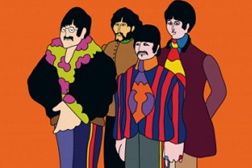
Director Robert Zemeckis (”Back to the Future”) will helm a new 3D version of the psychedelic animated Beatles classic “Yellow Submarine.” Daily Variety, which broke the 3D “Yellow Submarine” story, says a Broadway show and Cirque du Soleil production are part of the scheme.
Rights to the original 16 Beatles songs were “key to the deal,” Variety said (stating the incredibly obvious), but the reporter didn’t indicate if the music had been secured. Leaks to trade papers usually go out with the approval of the deal participants, however.
At best, we get a CG update and some great Beatles songs mixed for movie theater surround. At worst, we’re in for another “Sgt. Pepper’s” movie experience — remember that Bee Gees-Peter Frampton nightmare? And does anyone really need to see an “improved” Blue Meanie?
To be fair the Fabs didn’t have all that much to do with the original feature-length cartoon aside from the music. The Beatles did appear at the end in live action but actors did their cartoon voices, kinda dopey-like.
George Dunning, who worked on the Beatles’ Saturday morning cartoon series, directed the original film. It was released in 1968 to the delight of a stoned generation. Any top 10 of psychedelic movies would include the animated feature, which was surprisingly strange and included obvious drug references.
The Beatles said they enjoyed the film.
The movie “Yellow Submarine” hasn’t been treated all that well over the years, with the DVD version currently out of print. No major restoration has been undertaken, despite the opportunity to greatly update the sound. (The “Yellow Submarine” DVD goes for about $25 on Amazon, new and “like new” from third-party sellers.)
A “Yellow Submarine” Blu-ray can be considered overdue, like so many things associated with the Fabs.
The song “Yellow Submarine” is a showstopper number in the Cirque du Soleil production of “Love,” the killer remix a tease of what could be done … with the original movie.
The Beatles’ catalog is coming out in a few weeks, along with the Beatles Rock Band game.
Meanwhile, Tech Crunch just floated the idea that the long-awaited Beatles deal with iTunes could be announced on 9/09/09 as well.
There are two collections of the albums: “The Beatles Stereo Box Set” and “The Beatles Mono Box Set”
. Individual titles are coming to market as well.
Disney hopes to release the Zemeckis “Yellow Submarine” in time for the 2012 summer Olympics, Variety said.
The news comes a month after the original movie’s art director, Heinz Edelmann, died in Germany.
No. 33: ‘Eskimo Blue Day’
August 3, 2009
“Volunteers” found Jefferson Airplane in a radical mood. The 1969 album was overtly political, while most of the San Francisco group’s works to date had been concerned with romance, whimsy and matters of the head.
“We are forces of chaos and anarchy,” Grace Slick and Marty Balin sang on the opening track, “We Can Be Together.” The song shocked the squares and delighted the freak faithful with its soaring cry of “Up against the wall, motherfucker.” The band had plugged into radical chic.
More widely quoting swearing followed on “Eskimo Blue Day,” the seventh track, which saw the group embrace another social revolution: the nascent ecology movement.
“The human name doesn’t mean shit to a tree,” the lyric went, this news just in from the closest redwood.
The lyrics came from Slick, who shared songwriting credit with her Jefferson Airplane bandmate and lover Paul Kantner. The words exhibited her razor-wire ‘tude and his love of the obscure and exotic. The song seems to anticipate an awareness of global warming by decades — most likely luck, a psychedelic mindset and coincidence, but who knows.
Consider the evidence, in lyric fragments:
Snow cuts loose from the frozen
Until it joins with the African sea
In moving it changes its cold and its name …
If you don’t mind heat in your river and
Fork tongue talking from me …
Snow called water going violent
Damn the end of the stream
“Our greed does mean shit to a tree.” Slick said years later. “The trees are dying. All of our separating ourselves from the planet is stupid because, the larger picture, whether or not you become president of Bank America has nothing to do with evolution.”
The Airplane had become heavier in its old age, with “Eskimo Blue Day” a fine example of its late-period aggressive psychedelics, driven by the team of guitarist Jorma Kaukonen and bassist Jack Casady. The song begins moody and midtempo, building into a rock grove and then setting off a firestorm of distorted guitar, bass and drums.
After the song charges into head-banging territory, it returns to a hurricane eye of calm before charging off yet again. The dynamics over its 6 1/2 minute run are breathtaking. “Eskimo Blue Day” would become a showcase of the Airplane’s late-60s live shows and was part of their Woodstock set.
“Eskimo Blue Day” ends with what could be a glacier breaking apart, perhaps a man-made explosion, maybe the end of the world. An appropriately mysterious end to a baffling and prophetic song.
Read lyrics to “Eskimo Blue Day” by Grace Slick and Paul Kantner.
Buy “Volunteers” at Amazon
Organist wins ‘Whiter Shade of Pale’ case
August 3, 2009
The hassle over song credit and royalties for the psychedelic classic “A Whiter Shade of Pale” appears to be over. A court of Lords has ruled on the side of organ player Matthew Fisher, and against his old bandleader Gary Brooker.
Lyricist Keith Reid and Brooker were previously credited with writing the spooky rock ballad. Fisher’s contribution was the Bach-inspired organ theme, haunting and evocative. The song begins with his immediately recognizable eight-bar Hammond organ intro.
In 2006, the British High Court found Fisher was due 40% of the copyright, but no earnings prior to 2005. Last year, an appeals court ruled that Fisher was not entitled to royalties because he had waited decades to file the lawsuit. The Lords took up the “Whiter Shade of Pale” case in April.
Last week’s ruling by the Law Lords of the House of Lords reinstated the 2006 ruling, noting that Brooker and Reid had actually benefited from Fisher’s delay in seeking his credit and royalties.
Fisher, a computer programmer, has performed on and off with Procol Harum since its heyday. He told the BBC: “This was about making sure everyone knew about my part in the authorship. … A win without money was never going to be recognized as a win at all.”
Fisher said he had asked many times for piece of the psychedelic ballad’s fame and fortune, but was denied. The musician didn’t press too hard in fear of losing his job in a major rock act, he explained.
“A Whiter Shade of Pale” was a major hit on AM and FM radio during the ’60s, and has continued its successes as a popular soundtrack addition in TV and film, perhaps most famously in “The Big Chill.” There are hundreds of cover versions, and the song remains in heavy rotation on classic rock and oldies stations.
Procol Harum’s classic albums are being remastered and rereleased this year. Brooker remains the only original member of the band, which has seen numerous personnel changes over the decades.
“A Whiter Shade of Pale” is a top 10 entry on this web site’s Top 100 Psychedelic Songs of all time.
No. 16: The Crazy World of Arthur Brown
August 2, 2009
The airwaves of 1967 and 1968 were scorched by fire: First, the Doors’ “Light My Fire” and the Jimi Hendrix Experience’s “Fire.” Then came the self-proclaimed God of Hellfire, whose thunderous voice brought us “Fire.”
The U.K. trio the Crazy World of Arthur Brown ranks as a one-hit wonder these days — “Fire” gets steady play on classic oldies stations, and there was no follow-up of note. But the psychedelic cognoscenti revere Brown and his bandmates for the dark matter found on the first side of the debut album, “The Crazy World of Arthur Brown.”
“Fire” was the centerpiece of a side-long, five-track rock operetta once called “Tales From the Neurotic Nights of Hieronymous Anonymous.” Now, it’s mostly known as “The Fire Suite.” The rock opera king, Peter Townshend, associate-produced the “Crazy World” album and plays on one song.
“Nightmare: Prelude” opens the album (and song cycle) with a melodramatic horror-movie vibe, complete with funereal organ and what sounds like a psycho’s heavy breathing. (The title perhaps a nod to Bernard Hermann and “Vertigo.”) Sinister mood established, the rock trio bursts to life driven by the Hammond organ of Vincent Crane.
The story appears to concern young Hieronymous and the gods who visit him in his nightmares. The subject is hell, sin and a search for salvation.
“Why is it so cold out here? Let me in!” singer Arthur Brown pleads in a falsetto. “The price of your entry is sin,” a wicked god intones. And so the fun begins.
“Fanfare: Fire Poem” finds our hero begging to be released from some fresh new hell. Brown raps over a groove-intensive Mose Allison-style riff, flashing back to when he was lying in the grass by a river that suddenly turned into an inferno. (Note similarities to War’s “Spill That Wine” of two years later.)
The horrified hero sees “all these shapes being sucked into the flames, writhing and trying to escape.” A giant being invites him to “come on home” before plunging him into hell.
“I am the god of Hellfire and I bring you fire!” opens the famous hit, in which the vengeful satanic creature belittles the life of man — “fire — to destroy all you’ve done … to end all you’ve become.”
The sinister bounce of “Come and Buy” offers various temptations before reprising the “The price of your entry is sin” bit. “Time-Confusion” concludes our story with spooky-soulful playing by Crane that recalls both the nursery and funeral parlor. Then it’s back to “Fire.” The hero, alas, appears left in the devil’s hands, burning for eternity.
Brown performed much of this music wearing a flaming headdress and robes. (One writer said of Brown’s shtick: It was “the greatest single spectacle since the Rape of the Sabines.”)
Arthur Brown later said of his satanic stage persona, “For a while, I didn’t necessarily believe I was the devil, but felt as if I was supposed to lay things open for people to see. Thank goodness that side of myself disappeared. After a while you think: ‘God, how could I believe this?’ ” He also performed as the pope and later was crucified nightly as part of another act. The fire-hat act was captured on film for an unreleased movie, below. (Story continued)
Brown’s two-man band, organist Crane and drummer Drachen Theaker (later Carl Palmer) furiously pumped out the sounds. Crane was every bit as essential to the group’s success as Brown, exhibiting serious chops in soul, stride piano, jazz and classical.
There was no guitar. On “The Crazy World of Arthur Brown,” however, there were horns and strings, added by producer Kit Lambert. The producer apparently hated the playing of Brown’s drummer and used the excuse to go orchestral. Theaker, on tour, quit the band upon hearing the tarted-up album.
Crane has said there “probably three versions of every single song on that album, done in every single studio in London” with different players.
In the end, Theaker’s drumming remained on all but two tracks. He has told interviewers there exists a straightforward mix of the album, without strings and all, and with interstitial links between the Fire Suite tracks.
The extra instrumentation did nothing to stop “Crazy World” from becoming a top 10 album, while “Fire” blazed the top of the charts. Hearing an A-B comparison of the mixes would be great, but most fans would agree the horns and strings are far from sonic vandalism.
Side 2 of “The Crazy World of Arthur Brown” leans on the soulful side of Brown (the tall handsome singer had been pressured to go the Tom Jones route). The side’s highlight is a creepy and wonderful take on Screamin Jay Hawkins’ “I Put a Spell on You,” with Brown no doubt envisioning the American R&B singer’s famous stage entrances from inside a coffin. “We did psychedelic soul music,” Theaker has said. “A lot of people used to think (Brown) was colored.”
The album has come in and out of print in the decades since, marked by stretches in which it was a highly sought after collector’s item. In fact, a Japanese import of “The Crazy World of Arthur Brown” currently sells for $128 on Amazon, reflecting the need for a high-quality release in the West.
Update! “The Crazy World of Arthur Brown” returns in a double-CD edition in February 2010.
Brown initially tried to keep “The Crazy World” going, but moved on to the band Kingdom Come and a long solo career. He performs occasionally, still heavy on the operatic voice and strange theatrics. Vincent Crane, who went on to found Atomic Rooster, died in 1989 after decades of manic depression.
More reading: “The God of Hellfire: Alternative Biography.”