Sky Saxon of the Seeds dies; garage guru
June 26, 2009
Garage band icon Sky Saxon has died after a long career that included pop stardom with the Seeds and psychedelic explorations as a solo act. He was sixtysomething.
Saxon died Thursday in his new home of Austin, Texas, as he was preparing for a ’60s tour with the Electric Prunes and Love. The cause of death was not disclosed.
Saxon’s latest group was called Shapes Have Fangs, reflecting the singer’s eccentricity as well as his love of oddly titled songs and curious band names. He adopted the name Sky Sunlight Saxon in the years after the Seeds disbanded. Richard Marsh, his real name, was born in Utah.
The Seeds’ two albums remain a powerful influence on rock music, ranging from the jukebox hits “Pushin’ Too Hard” and “Can’t Seem to Make You Mine” to the sex saga “Up in Her Room,” clocking in at 15 minutes. The song “Mr. Farmer” has become another signature song over the years and was heard in the rock movie “Almost Famous.”
Saxon and his L.A.-based Seeds obviously influenced Jim Morrison and the Doors, who had supported them on tour. “The End,” for example, appears to be a direct cop of Saxon’s spooky baritone narration. In turn, Saxon explored some Doors-like directions after the original Seeds disbanded.
The Seeds provided a bridge between some of the original three-chord attitude rockers such as the Kingsmen and the edgier psychedelic bands. Later, the Seeds’ brand of garage rock reverberated throughout the punk rock movement. Generations of rockers have covered Saxon’s songs.
The bands’ two albums, “The Seeds” and “A Web of Sound,” are available as a two-fer CD, as are the Saxon albums “The Future” and “A Full Spoon of Speedy Blues”
. (continued)
The Seeds reunited in 2004 for the album “Red Planet,” which retained the fuzz tone guitars and Farfisa organ sound of their mid-’60s recordings.
Several of Saxon’s post-Seeds records are out of print or only available as imports. “Transparency” (2005) is available via Amazon. Other recordings such as the original release of “Future”
with the Seeds go for as much as $100. He was big in Japan. (View the Sky Saxon discography.)
Saxon recorded with the Smashing Pumpkins leader Billy Corgan last year and appeared in one of that band’s psychedelically influenced music videos.
Saxon was a member of the famed L.A. commune the Source Family and performed with its psychedelic jam band the YaHoWha.
Saxon’s wife, Sabrina, announced the death on her Facebook page: “Sky has passed over and YaHoWha is waiting for him at the gate. He will soon be home with his Father. I’m so sorry I couldn’t keep him here with us. More later. I’m sorry.”
Update: A tribute to Sky Saxon at the EchoPlex in L.A. featured Billy Corgan from the Smashing Pumpkins, the surviving members of the Seeds, the Strawberry Alarm Clock and the Electric Prunes. Here’s an outstanding video of Corgan and a one-time band (including Smashing Pumpkin Mark Byrne and SAC organist Mark Weitz) working out to Saxon’s “900 Million People Daily (All Making Love).”
Weird Al dupes the Doors
June 16, 2009
Weird Al takes on Jim Morrison and Craig Newmark in his latest video spoof, working out as the Lizard King to a mashup of Doors classics.
The “Craigslist” single and video were released today, and spread like light-my-wildfire.
The psychedelic band’s original keyboardist, Ray Manzarek, contributed the keyboards for the video, directed by Liam Lynch (”Tenacious D in: The Pick of Destiny”). The song starts as “When the Music’s Over” and blends into “Soul Kitchen,” “20th Century Fox” and other Doors hits.
Lynch and “Weird Al” Yankovic made the ersatz psychedelic music video in the director’s garage.
“Lower your expectations,” Yankovic warned on his MySpace page. “(The last video) ‘White & Nerdy” had a huge budget, and “Craigslist” had a miniscule one.
“The low-budget vibe happens to dovetail well with the concept of the video, so don’t worry, it all works out fine,” the parodist says. (continued)
The “Craigslist” brings in some iconic Morrison imagery, such as the golden lights of L.A. and the Indian car crash the singer witnessed as a boy. The video includes a somber Morrison-style spoken interlude, riffing on some jerk with a cell phone holding up the line at the Coffee Bean. What does this have to do with anything? … In fact, what does Morrison have to do with Craigslist?
“I thought it would be anachronistically weird to have me as Jim Morrison screaming about Craigslist,” Yankovic told Spinner. “That just seemed so completely wrong that I thought I had to do it.”
Morrison had to dump some pounds to fit into the Lizard King’s leather pants (although late Morrison certainly would have worked for the “Fat” video).
“Craiglist” is the first of several songs to be released this summer from Yankovic’s upcoming digital EP, “Internet Leaks.”
Weird Al’s last video came three years ago, with the rap parody “White & Nerdy.”
“Craigslist” is his first video foray into psychedelia.
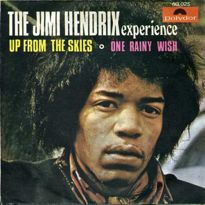
No. 41: ‘EXP,’ ‘Up From the Skies’
June 13, 2009
“A rather peculiar-looking gentleman” arrives for a radio interview.
When asked to comment about “this nonsense about space ships and even space people,” he responds by melting, elevating, transforming, transcending … and then departing on the intergalactic vessel cloaked as Jimi Hendrix’s guitar.
After all the sonic fireworks, another alien addresses mankind on the topic of our planet, this time bopping along on a relaxed jazz beat:
“I just want to talk to you, I won’t do you no harm.
I just want to know about your different lives,
on this here people farm.”
So begins the Jimi Hendrix Experience’s second album, “Axis: Bold as Love.”
In May 1967, Hendrix’s first album was released, quite likely the most startling record debut in history. The left-handed guitarist immediately become one of the biggest stars in rock. Seven months later came the hugely anticipated “Axis.”
The radio skit, “EXP,” opened the album, a 1:55 prelude to “Up From the Skies.” Drummer Mitch Mitchell and Hendrix play the talk show host and alien, respectively. As Hendrix’s extraterrestrial speaks (”You just can’t believe everything you see and hear … can you?”), his voice slows to a slur as the effects-drenched guitar swirl begins, chasing itself from speaker to speaker.
As the turmoil subsides, we’re left with another major surprise from Hendrix: “Up From the Skies” begins immediately, with a sprightly Mose Allison jazz feel. Mitchell plays cocktail lounge-friendly brushes on his drums. Hendrix’s guitar streams through a wah-wah pedal, no doubt a first for jazz rock (pretty much an oxymoron in ‘67). The song was recorded two days before Halloween 1967.
The cosmic one-two punch of “EXP” and “Up From the Skies” was an early sighting in what was later dubbed “Alien rock.”
Hendrix’s mystical qualities included a good deal of prescience, as “Up From the Skies” anticipates the eco-nightmares to come — this a year before the release of “The Whole Earth Catalog”:
“I have lived here before, the days of ice.
And of course this is why I’m so concerned,
And I come back to find,
the stars misplaced and the smell of a world that has burnt.
The smell of a world that has burnt.”
“Up From the Skies” has inspired a galaxy of covers, including those by Rickie Lee Jones, Gilberto Gil, Joan Jett, Kenny Rankin, jazzmaster Gil Evans and various crossover classical outfits such as the String Quartet.
Hendrix continued to use his alien as a narrator for songs and sometimes told friends he was sent to Earth from another place. Who’s to say?
Further reading: “Room Full of Mirrors: A Biography of Jimi Hendrix.”
“Up From the Skies” chords
“Up From the Skies” lyrics, by Jimi Hendrix
I just want to talk to you, I won’t do you no harm.
I just want to know about your different lives,
on this here people farm.
I heard some of you got your families,
living in cages tall and cold,
And some just stay there and dust away, past the age of old.
Is this true? Please let me talk to you.
I just want to know about the rooms behind your minds,
Do I see a vacuum there, or am I going blind?
Or is it just a remains from vibrations and echoes long ago,
Things like ‘Love the world’ and ‘Let your fancy flow’,
Is this true? Please let me talk to you.
Let me talk to you.
I have lived here before, the days of ice.
And of course this is why I’m so concerned,
And I come back to find,
the stars misplaced and the smell of a world that has burnt.
The smell of a world that has burnt.
Yeah, well maybe, maybe it’s just a change of climate.
I can dig it, I can dig it baby. I just want to see.
So where do I purchase my ticket,
I just like to have a ringside seat.
I want to know about the new Mother Earth,
I want to hear and see everything (3x)
Yeah. Aw, shucks, If my daddy could see me now
Soft Machine’s Hugh Hopper dies
June 12, 2009
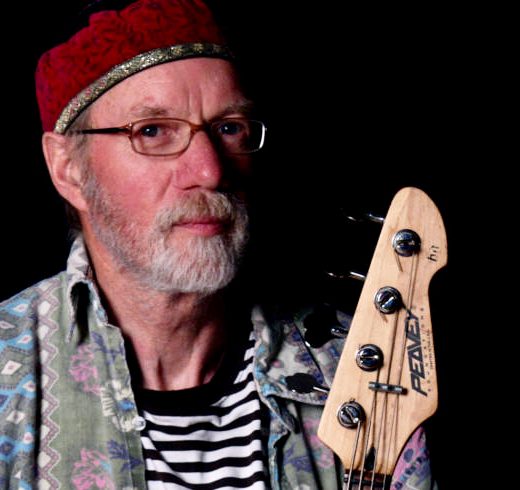
The bassist Hugh Hopper, a contributor to a sea of progressive bands but best known for his tenure with Britain’s pathfinding Soft Machine, has died. He was 64.
Hopper was one of the central figures in the Canterbury music scene, both before and after his days with Soft Machine. He joined the band as a roadie and then took over on bass in 1968, after the departure of founder Kevin Ayers.
He was among the first bassists to successfully apply fuzz-tone effects to the instrument. His playing anticipated the jazz-rock styles of Jaco Pastorious and Stanley Clarke, but Hopper’s playing was rarely flashy. He had a Motown-like dedication to anchoring the ensemble playing.
Hopper played and contributed songs to almost all of the Soft Machine’s classic works (the second through sixth albums), as the band moved from psychedelic musings to fusion/progressive rock.
One of the most influential Hopper compositions was the trippy, noisy, sometimes atonal “Facelift,” which opened the “Third” album, clocking in at 19 minutes. The avant-garde showcase brought to mind the contemporaneous explorations of Frank Zappa and Miles Davis.
On the “Fourth” album, he contributed “Kings and Queens,” a more traditional jazz rock piece with a cinematic feel. His Soft Machine song “Memories” was recorded by Whitney Houston. (continued)
Hugh Hopper was an early innovator in the use of tape loops as foundations for instrumental improvisation. His first solo album, after he left Soft Machine in 1973, include a side-long sonic collage.
The bassist fronted his own bands and also worked with Gong, Carla Bley, Dave Stewart, Stomu Yamash’ta and Gary Windo, among many others.
Hopper worked with most of the like-minded European players of the past four decades. His long list of collaborators included old Soft Machine mates such as Elton Dean, the free jazz saxophonist.
In the new century, Hopper celebrated his Soft Machine years in the bands Soft Works and Soft Machine Legacy.
The bassist worked until June 2008, when he had to cancel a tour of Japan due to back problems. He then learned he had leukemia. Several benefit concerts helped cover medical expenses. Hopper died June 7 in the county of Kent, England, two days after marrying his longtime girlfriend.
Woodstock tour reunites fest bands
June 10, 2009
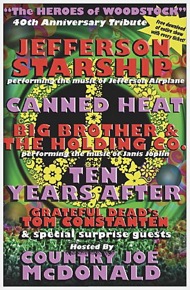
In this summer of all things Woodstock, some of the best bands from that sainted mud fest are hitting the road on a package tour.
Jefferson Starship (Airplane), Country Joe, Ten Years After, Big Brother and the Holding Company and Quicksilver Messenger Service will strive to bring back the vibes.
The 40th anniversary of Woodstock flashback experience will be less than complete, of course, with the passage of all these years. But most of these acts have stayed active over the decades and should turn in good shows.
Jefferson Starship doesn’t touch down with Grace Slick or Marty Balin; Ten Years After performs without Alvin Lee these days; Canned Heat’s key talent died back in the day; Big Brother continues on without Janis Joplin; and the psychedelic Fish have long since disappeared from folk singer Country Joe’s bucket.
The Heroes of Woodstock show stops in Bethel, N.Y. (nearest city to the Woodstock fest) on Aug. 15. Kicking it up for that anniversary event will be Levon Helm (the Band) and Mountain.
Key tour stops include New York City (Aug. 12), Philadelphia (Aug. 18), Los Angeles (Aug. 23) and the Sausalito Arts Festival (Sept. 7). Expect to see most but not all artists at each stop.
The tour operates with a license from Woodstock Ventures and has the corporate backing of Warner Bros., which has released a new version of the “Woodstock” movie, as well as its label Rhino, which plans a massive CD box set of the festival’s performances.
Meanwhile, the fourth edition of Hippiefest returns to the road July 21, running through Aug. 16.
Artists are marginally in the psychedelic arena, if at all, but ’60s music fans should be pleased to catch up with Mountain, Felix Cavaliere (Rascals), Mitch Ryder, Brewer and Shipley, Chuck Negron (Three Dog Night) and Joe Molland of Badfinger.
Last year’s Hippiefest included Jack Bruce of Cream, who wandered through some of the legendary power trio’s more esoteric songs. Also aboard were Eric Burden and his latest rendition of the Animals.
The hosts are the lovely Flo & Eddie (pictured), who always come prepared with plenty of acid casualty jokes. They’ll sing their Turtles hits, which hold up brilliantly as performed by their spot-on band. Last year, the whacked-out duo ordered everyone under 21 out of the Greek Theatre, sort of kidding.
Major tour stops for Hippiefest are in Detroit (July 21), Baltimore (July 23), Minneapolis (July 28), L.A. (July 31), San Diego (Aug. 2) and Fort Lauderdale (Aug. 16).
If you’ve seen the shows, please post a short review via the comments. Psychedelic Sight will behold the concerts in L.A.
Read the 2008 Hippiefest concert review.
Prunes, Love, Saxon head East
June 9, 2009
The “California ‘66 Revue” brings together three key acts from that pivotal year in rock history: the Electric Prunes, Love and the Seeds (repped by singer Sky Saxon).
(Update: Sky Saxon died June 25. He was replaced on part of the tour by Moby Grape guitarist Jerry Miller.)
Update of Aug. 6: The tour now appears down to Love, Miller (on some dates) and “special guests.” The tour web site announced the Electric Prunes would only play the WPKN benefit on Aug. 6 in Fairfield, Ct. That show also reportedly will feature a Blues Magoos reunion. Love (Baby Lemonade) plan to continue the California ‘66 tour in venues that want to keep the booking, the web site said. The clubs should: This version of Love is well worth seeing and includes original member Johnny Echols.
Recalling the heady days of the Sunset Strip, the package tour in August makes a run up the East Coast, into Canada and over into into the Midwest.
The Prunes founders James Lowe and Mark Tulin came up with the concept of touring behind the year 1966, which saw garage rock and folk rock merge into early strains of psychedelia.
Love, one of the greatest bands of the psychedelic era, carries on after the death of founder Arthur Lee. Original Love guitarist Johnny Echols is at the helm, at least figuratively. This is no exploitation act — the new Love, in reality L.A.’s Baby Lemonade, were Lee’s band in the years of his post-prison comeback. They perform Lee’s masterworks from “Forever Changes” with precision and verve. Love’s songs and albums are solid citizens on this web site’s lists of the best psychedelic albums and best psychedelic songs.
The Electric Prunes scored one of psychedelia’s first radio hits, “I Had Too Much to Dream (Last Night).” Their “Mass in F Minor”” concept album was among the most ambitious of the era, despite its somber bloat. One of the movements of this rock Catholic Mass was used in “Easy Rider”
Sky “Sunlight” Saxon led L.A.’s the Seeds in the mid-’60s, defining garage rock with the howling hits “Pushin’ Too Hard” and “Can’t Seem to Make You Mine.” Their second album, “A Web of Sound,” featured one of the first long rock workouts, “Up in Her Room,” clocking in at 15 minutes. While the Seeds found immortality as a garage band, Saxon moved on to psychedelic explorations in following years. The Seeds appeared in the hippie movie “Psych Out” with Jack Nicholson. Saxon moved to Austin recently and had a new band, Shapes Have Fangs.
Tour promoter Patrick Hand said he wanted to see how the revue was received in “intimate venues”: “If the public is as enthusiastic in attending the shows as the clubs have been in booking, then I have no doubt we’ll be back on the road later in the year.”
California ‘66 tour dates include Philadelphia (Aug. 4), Montreal (Aug. 8), New York (Aug. 9), Chicago (Aug. 12), Detriot (Aug. 15) and Cleveland (Aug. 16).
Related content: Woodstock tour reunites fest bands
Procol Harum, Dukes fuel own reissues
June 8, 2009
The members of Procol Harum and the Dukes of Stratosphear have taken charge of their vintage works by steering the albums’ reissues on CD. The albums come from the original master tapes and offer generous collections of bonus tracks selected by the artists.
Procol Harum, of course, is the English band best known for the haunting 1967 hit “A Whiter Shade of Pale,” one of the most popular songs in rock history. Their first two albums proved hugely influential, inspiring Queen, Pete Townshend, the Band as well as the genres of prog rock and (to some extent) heavy metal.
The Dukes of Stratosphear, on the other hand, were influenced by pretty much anyone of note in Britain’s 1960s psychedelic scene. The fictional band dropped their cover story in the liner notes to the resissues of their two CDs and are now fully identified as members of the 1980s band XTC — not that the XTC side project was ever much of a secret. The two reissues of recordings from 1985 and 1987 comprise the totality of the Dukes output.
Procol Harum’s “A Whiter Shade of Pale” and “Shine on Brightly” are leaving for the U.S. coasts this week as part of the 40 Years reissue series from Britain’s Fly/Salvo labels. Those albums, plus “A Salty Dog” and “Home,” have been available in Europe since April and May (and in the U.S. via Amazon UK).
The new version of the oft-changed debut album can be identified by its shocking pink (Italian) version of the cover. All of the reissues are marked with “40 Years” labels on the covers. Amazon U.S. has made a mess of the proper CD release dates and song listings of these albums, so make sure you’re getting the new ones. Follow the links to the U.K. store for correct information on “Procol Harum” and “Shine on Brightly.”
Procol Harum leader Gary Brooker and lyricist Keith Reid helped the record label with the reissues, while Brooker curated the generous bonus tracks for these albums. “Procol Harum” includes the group’s two initial singles, “Whiter Shade of Pale” and “Homburg,” which weren’t on the original album (typical of the times, see the Beatles).
“Shine on Brightly” was among the group’s best albums, tight and mysterious. Guitarist Robin Trower had joined the band at this point (his best work would come on the “Broken Barricades” LP, also set for rerelease on Salvo. The “Shine on Brightly” cover, unfortunately, is not the one U.S. audiences remember from back in the day (the psychedelic green art with the mannequin and the piano).
The Procol Harum reissues come from the original masters and return production elements of the sound that haven’t been heard on previous digital versions. Early reviews rave about the audio but point out that the albums are in the original mono. Some of the bonus tracks are in stereo.
The unreleased “Understandably Blue” song on the debut album’s bonus tracks is another draw for fans and collectors.
The Procol Harum CDs are said to include online bonus materials, a la Blu-ray Live, although the label’s web site refers to a lack of content so far.
The Dukes of Stratosphear reissues also come from the original analogue tapes. Group members Dave Gregory, Colin Moulding and Andy Partridge wrote individual liner notes that are informative and typically odd. The sound seems more wide open and detailed than on the previous CD release, a compilation called “Chips from the Chocolate Fireball” from 2001.
The original Dukes record, “25 O’Clock,” was an EP with six songs. The follow-up work, “Psonic Psunspot,” was a full album. Neither has been released individually on CD until now. A healthy serving of alternate versions and demos fills out both CDs, released by Ape Records.
“25 O’Clock” is named after the bogus group’s best song, while “Psonic Psunspot
” is a more realized project. “Psunspot” songs derive from obvious influences (Electric Prunes, the Kinks, early Pink Floyd, Brian Wilson, the Beatles). It leans on the whimsical side of the psychedelic genre — think “For the Benefit of Mr. Kite,” not “Tomorrow Never Knows” — “See Emily Play,” not “Echoes.”
The vibe would carry over to XTC’s masterpiece “Skylarking,” produced by Todd Rundgren.
Partridge, XTC’s leader, noted with a big wink: “The Dukes were the band we all wanted to be in when we were at school. Purple, giggling, fuzztone, liquid and arriving. If you want to know where those cheap charlatans the Beatles, Pink Floyd, the Byrds, the Hollies and the Beach Boys stole their ideas from, well just listen to this and weep.”
The somewhat reclusive bandleader Andy Partridge did a long interview with the Chicago Tribune’s Mark Caro that’s worth a read for any XTC/Dukes fan. He has this to say about psychedelic music:
“I think a lot of the allure of that psychedelic thing and specifically psychedelic singles was that kind of compact magic, all these effects that people hadn’t heard before and everybody looking for new ways of mashing up conventional sounds in the studio. And of course these days you’d just lean on a button, and there it is; it’s all sampled and pre-screwed-up for you. But then you really would have to play an electric saw at the bottom of a well and then have that spun in backwards and stuff like that.”
Of the two Dukes records, Partridge says: “To me they just look like the next XTC records. Because ‘Skylarking,’ which happened between the two Dukes releases, is like the missing Dukes album, or vice versa. ‘Psonic Psunspot’ is the missing XTC album after ‘Skylarking.’ There’s no barrier.”
“Skylarking,” produced by Todd Rundgren in infamously stormy recording sessions, no doubt will find a place on the Top 50 Psychedelic Albums list, along with “Psunspot.”
Both new Dukes CDs feature the promo videos for each album’s single. The packaging is sublime, bringing to mind small hardcover books printed with great care. All collectors editions should look so good.
No. 37: Love’s ‘Da Capo’
June 2, 2009
Seconds into the opening track, “Stephanie Knows Who,” it’s clear that “Da Capo” represented new directions for Love and for rock.
A harpsichord dances with guitar in the lovely prelude. A deep-throated sax breaks in. In the break, all of the song’s instruments collide and veer off in different directions. The resulting passage is more in tune with free jazz than psychedelic music — although this is unmistakably a hard rock song.
“Da Capo” was Arthur Lee and Love’s second album, out of three made with the his core group of L.A. musicians. The album was followed and overshadowed by the rock masterpiece “Forever Changes,” but the songs here are streaked with brilliance and innovation. Many musicians’ minds were blown by its collage of sounds and crazyquilt of influences, the material clearly ahead of its time.
“Da Capo” is, in a sense, a more adventurous album than “Forever Changes.” In any case, these tracks are among the finest recordings of Love as musicians. (Much of “Forever Changes” was played by hired hands.)
The band had expanded to seven players, upgraded its drummer, added woodwinds and, of all things, integrated a harpsicord. The first side of “Da Capo” is a lovely experiment in fusing sounds from rock, Latin rhythms, jazz and classical. Lee and company succeed at this without pandering, producing some of their best songs. The second side of “Da Capo,” alas, is dedicated entirely to the notorious jam “Revelation,” which has done great damage to the otherwise brilliant album’s rep.
“Seven & Seven Is” could be the most explosive 2 1/2 minutes in ’60s rock. When rocks fans think of Love, they usually conjure up “Forever Changes,” “My Little Red Book” and this frantic yet somehow cohesive piece. The rage of drums, bass and guitar gives way to the sound of an atomic bomb explosion, accompanied by a jazzy soft guitar. The a-bomb apparently had nothing to do with the song’s content, a visit to Lee’s family living room. The song anticipates punk rock and sonic anarchy. A work that’s forever cool. “Seven & Seven Is” was covered by the Ramones and Alice Cooper among many others.
Legend has it that Lee and the band’s original percussionist, Snoopy Pfisterer, alternated playing the difficult and exhausting drum part, with no one sure whose work appears on the album. Some versions of the album have a version of the song preceded by 50 seconds of studio patter that captures Lee’s frustration with “take 77.” (Pfisterer, classically trained, moved to harpsichord and organ for this album.)
“Orange Skies,” from the band’s terrific second songwriter Bryan MacLean, brings us the delightfully trippy lyric “Orange skies, carnivals and cotton candy and you.” Touches of samba with Tijay Cantrelli’s flute as the lead instrument. “Que Vida!” continues the theme, with a B3 organ streaming below the surface.
“The Castle” shows off the chops of new drummer Michael Stewart and features a jangly take on Spanish fingerpicked guitar. Listen for the quick detour into dissonance.
“She Comes in Colors” is Love’s version of a power ballad. A flute drifts over the love song, sung with precision by Lee. About 20 seconds in, the song shifts from an easy tempo to barely restrained rock. The harpsichord returns midway though. “My love she comes in colors,” Lee sings over and over. “You can tell her from the clothes she wears.” The care and precision in the production foreshadow “Forever Changes.” Keith Richards said “She Comes in Colors” inspired the Stones’ “She’s a Rainbow.”
The 19-minute “Revelation,” a bluesy/R&B jam that by most accounts Lee and the band came to regret using on the album. It’s all pretty much downhill from the harpsichord intro. There are some good moments about six minutes in, with some Eastern-sounding guitar chops most likely influenced by the Butterfield Blues Band’s “East/West.”
At times, the jam brings to mind the Stones or Love’s labelmates the Doors, who debuted that year and were big fans of Arthur Lee’s band. (”Stephanie Knows Who” certainly influenced the Doors’ later “Touch Me,” although that might be producer Paul Rothchild repeating himself.) Yes, there’s a drum solo in “Revelation,” but it’s mercifully brief. Since the core version of Love made only three albums, the loss of a side to filler stings. (Though the laziness probably routed several great songs to “Forever Changes.”)
The album was rereleased several years ago, as a Rhino/WEA import. It offers mono and stereo versions of “Da Capo.”
Rhino’s “Love Story: 1966-1972″ provides a good overview.
People who already fans of this groundbreaking band should check out “Love Story,” a documentary made in Lee’s final years.