No. 4: The Beatles’ ‘Sgt. Pepper’
January 28, 2009
If asked to cite a psychedelic music album, most casual music fans would reply, without hesitation: The Beatles’ “Sgt. Pepper’s Lonely Hearts Club Band.”
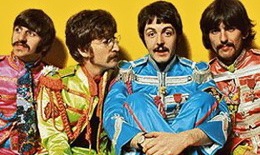
The Fabs’ embrace of flower power and trippy-dopey imagery was in full bloom in the summer of 1967, when the multicolored “Sgt. Pepper” tumbled onto the world stage.
This was not, however, the Fabs’ first visit to the land of psychedelia: “Tomorrow Never Knows” from “Revolver” startled fans the summer before, with its frenzied pace and sea of tape loops. Lennon’s slithery acid-tinged “Strawberry Fields Forever” arrived as a single more than three months before, sharing the vinyl with the gentle psychedelia of “Penny Lane.”
For the Summer of Love, the gods of pop had delivered a soundtrack. “Sgt. Pepper” would change the lives of a generation or two, expanding minds young and old across the universe.
But does “Sgt. Pepper” deserve its medals as a landmark psychedelic album? Yes, certainly, but its trippy credentials do wither a bit under examination.
Of course, hallucinatory drugs heavily affected the Beatles who had been taking LSD for a year or two. The liberal use of sound effects, backward tapes and nonsensical sonics gave a veneer of strangeness to even the most conventional songs, such as “Lovely Rita.”
The idea of a rock concept album — with songs fading into each other and presenting some sort of narrative whole — was highly innovative and challenging to listeners of the day, but it was not unique, not even in Britain.
The English music-hall influence is as strong if not stronger than the pull of psychedelia. As pop artists and marketing geniuses, The Beatles knew better than to blow their constituency’s collective minds, as Lennon had in mind with “Revolution No. 9.”
A cosmos-minded mix-tape that stretches from “Revolver” to “Magical Mystery Tour” would indeed reveal the Beatles as the greatest psychedelic band of them all. Still, “Sgt. Pepper’s” rep as the nexus for these adventures remains overblown.
Here are the songs that clearly qualify for anyone’s psychedelic hall of fame:
- Lucy in the Sky With Diamonds (Lennon)
- Being for the Benefit of Mr. Kite! (Lennon)
- Within You and Without You (Harrison, playing with Indian musicians)
- A Day in the Life (Lennon and McCartney
That’s four out of 13 songs, leaving nine tracks revolving at various distances from the psychedelic orbit.
So why, then, does “Sgt. Pepper’s Lonely Hearts Club Band” qualify for top 5 placement on our list of the greatest psychedelic music albums?
The album remains a marvelous immersive experience, a journey through a sonic soundscape that welcomes and inspires all but the smallest of minds. As with works of painted art, sometimes the frame matters as much as the images on canvas when it comes to the aesthetic experience.
And, of course, “Lucy in the Sky” and “A Day in the Life” are as good as it ever got in psychedelic songwriting and production. (Imagine the album with “Strawberry Fields,” the original plan.)
To hear the final massive E chords of “A Day in the Life” decaying but seemingly going on forever takes us backward and forward in the same instant. No other recorded moment in rock history matches this one for drama.
“Sgt. Pepper’s Lonely Hearts Club Band” will be among those remastered and rereleased in fall 2009. For now, alas, the CD has not changed since the mid-1980s, when the first and only digital version of the psychedelic classic hit stores. As in, the release dates back to 20 years ago today (more or less). That bit of absurdity will blow anyone’s mind.
Pink Floyd’s Richard Wright dies
January 21, 2009
Pink Floyd keyboardist and founding member Richard Wright has died at age 65.
Wright’s circus of sounds — odd, spooky, lush or piercing as the occasion required — was the foundation of the psychedelic music the London-based band rode to the top of the rock world.
Guitarist/singer David Gilmour said: “In the welter of arguments about who or what was Pink Floyd, Rick’s enormous input was frequently forgotten. He was gentle, unassuming and private but his soulful voice and playing were vital, magical components of our most recognized Pink Floyd sound.”
Wright co-wrote the “Dark Side of the Moon” centerpiece “The Great Gig in the Sky” and contributed to almost all of the band’s classics of 1960s psychedelia.
Wright was born in London in 1943. In school, he joined a rock and R&B band with guitarist Roger Waters and drummer Nick Mason, playing American covers under various names, including the Tea Set.
Syd Barrett joined the group, which became Pink Floyd. Barrett steered the band toward a mix of curious twee pop, and then into the early works that led to full-blown psychedelia on albums like “Ummagumma,” “Atom Heart Mother” and “Meddle.” Barrett, who died in 2006, left Pink Floyd as a result of his LSD use and mental problems.
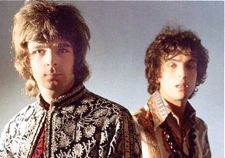
(Wright, left, is pictured with Barrett.)
The keyboardist released a pair of solo albums. He clashed with Waters and left the band briefly. Wright reunited with Gilmour and Mason in the fractured Pink Floyd that survived the stormy exit of Waters in 1985.
Wright died on Sept. 15, 2008. The cause of death was cancer, his publicist said.